Sign up for the Slatest to get the most insightful analysis, criticism, and advice out there, delivered to your inbox daily.
It’s been a bumpy ride lately for air travelers. Across the United States, major airports have been inundated by flight disruptions, security lines spilling out of terminals, air traffic control outages, and overworked and understaffed employees struggling to keep it all running.
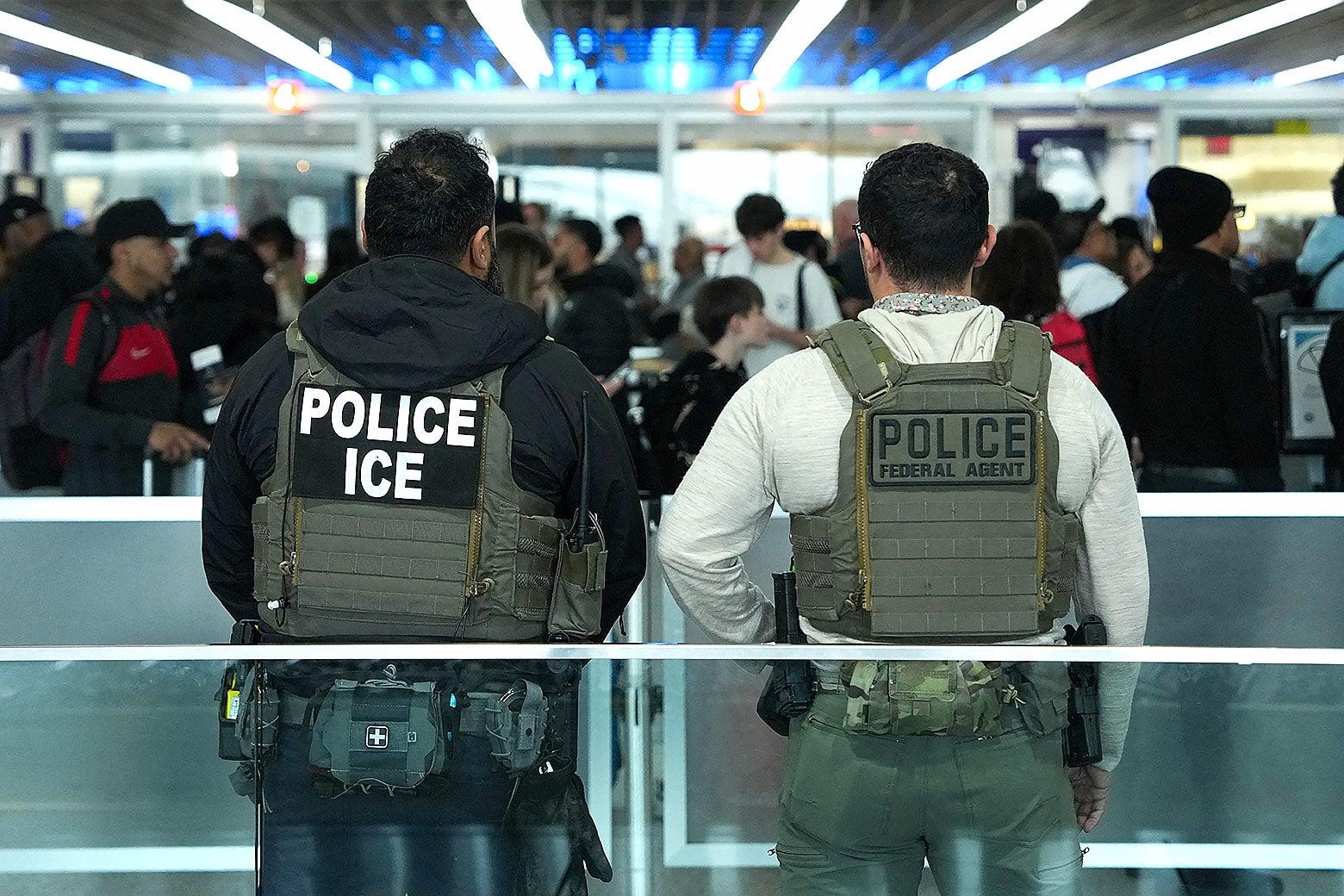
The chaos, which began ramping up after a congressional budget fight shut down the Department of Homeland Security last month, seemingly reached a fever pitch over the weekend. President Donald Trump ordered Immigration and Customs Enforcement officers to help fill in for still-unpaid Transportation Security Administration and Federal Emergency Management Agency officials, many of whom have called out of work. Air traffic control staffing shortages led to a brief ground stop at Newark Liberty International Airport and seem to have been connected to a fatal on-ramp collision at New York’s LaGuardia Airport—which closed down this essential air travel hub for over 14 hours and is keeping the affected runway off-limits through the coming week. Cellphone footage of crowded security lines and aggressive plainclothes ICE arrests has flooded social media; Atlanta’s official subreddit is now dedicated to updating local residents and prospective passengers on the chaos at the capital city’s international airport. As of this writing, no matter where you’re flying from, the panic remains palpable.
With this chaos having spread so suddenly—thanks in part, naturally, to a weekend Fox News segment that appears to have raised the very idea of an ICE airport surge to Trump—the big question now is how much longer it will last. Unfortunately, the signs are not promising for those desperately hoping that air travel will smooth back out anytime soon. (Sorry to all you college kids on spring break.)
The most pressing contributor is Homeland Security funding. Beginning in January, after the horrific killings in Minneapolis, Democrats refused to support any DHS appropriations bills that didn’t mandate further legal constraints around federal immigration efforts. The GOP attempted to sidestep this opposition by proposing an all-or-nothing DHS funding resolution by February—a move that ultimately failed, fueling a wholesale department shutdown that has been in effect since Feb. 14. (Trump himself has added extra wrinkles by ordering the GOP not to approve any DHS-reopening legislation that doesn’t incorporate his SAVE America Act, a voter-suppression bill that Dems continue to obstruct.) Since then, thousands of TSA agents have either called out of work or quit their jobs altogether; the remainder have been forced to work without pay, and without their typical levels of staffing support. The recent hullabaloo seems to have pushed Republicans to try to reach a funding compromise, with Sen. Susan Collins informing Politico that an agreement could be reached “by the end of the week,” assuming that the president approves (something that is hardly a given).
Sheldon Jacobson, an engineering professor at the University of Illinois Urbana-Champaign and a regular commentator on the aviation industry, tells me that the capacity issues are directly attributable to the lack of TSA pay. “Some of these agents have to use sick time or vacation to go and make some money because they’re not getting a paycheck,” he said. “They know they’re going to get paid eventually. They don’t want to not work. But they have to find a way to get some income to cover day-to-day bills.”
This had already, over the past month, fueled extended wait times at airport-security stations across the country. Flight attendant unions and advocacy groups for airline executives, recognizing the warning signs, have repeatedly begged the federal government to figure out a funding backstop for TSA salaries. Yet Trump has seemingly done all he can to only make matters worse. A Monday-morning Punchbowl News item indicated that Senate Republicans were ready to make a weekend deal with Democrats to fund all DHS operations except for ICE—yet Trump refused to approve such a compromise, once again insisting that the SAVE Act be made part of any agreement. With that, all progress was vanquished, and ICE agents (who are still being paid, thanks to a carve-out provision of the One Big Beautiful Bill Act) were instead deployed as an interim solution. (In a public statement, the president of the American Federation of Government Employees union slammed the decision, noting: “Putting untrained personnel at security checkpoints does not fill a gap. It creates one.”)
One more key factor: the Iran war. Major companies have already been scrambling to rework their routes and flight schedules; with the Middle Eastern conflicts dragging on, these companies have been forced to take a major hit to revenue and operations as flyers remain stranded across the Gulf. Add to that the international oil-price shocks from the ongoing attacks on energy infrastructure, which have already forced airlines to raise ticket costs and prepare for advance panic bookings from passengers looking to save money before expenses rise even more. No matter when (or if) the Iran campaign ends, these interruptions will ripple throughout the rest of the year.
It’s not easy for travelers to figure out how to manage in the meantime because, as Jacobson points out, the situation changes from day to day, airport to airport. “You have different checkpoint lanes that you need a critical mass of people to operate. If you don’t have enough, you have to close down the lanes. And it can be different airports on different days because of who’s showing up for work,” he told me, adding that TSA officers are required to undergo weeks of training that interim ICE agents just aren’t. And the line items for TSA paychecks and training are already in Congress’ budget; it’s just a matter of passing a bill that actually puts that money into the system. That’s much easier said than done when the president, who has to sign off, has other priorities in mind.
Still, there are mitigating steps passengers can take for now, as analysts with the Points Guy have noted: arriving hours (and hours) in advance of their trip, following flight updates directly from corporate airlines instead of from TSA, and getting in on PreCheck if your local airport still has it. Such preparation may be necessary for a few weeks yet; even if TSA agents are fully paid and restored to their jobs by this weekend, it will take a while longer for the disorder to abate. Air traffic control labor shortages and equipment outages, which have been chronic issues since the wake of COVID-19, are likely to persist unless the Federal Aviation Administration is given better resources. There’s also the matter of withdrawing ICE, restoring security agents to normal work schedules, and rapidly training more TSA officers to make up for those who resigned altogether. If all goes well, things could clear up by summertime.
For the time being, most airports across the country remain operational, and airlines like Delta are working to rebook and reschedule flyers as needed. (The company is also ramping up pressure on Congress by revoking special flight perks for lawmakers until the DHS shutdown concludes.) But if the shutdown does not resolve soon, the fallout from this weekend may feel like paradise in comparison to what’s to come. Those looking to avoid larger air hubs will find no relief at smaller, domestic regional airports, which have been hit all the harder and face the possibility of temporary closure. And Trump is not likely to back down from his barking demands, whether those pertain to halting everything on behalf of the SAVE Act, threatening Iran with further aggression, or leaving essential government functions to rust even as ICE agents retain their salaries and work opportunities. As ever, it all comes down to the big man in the White House.