Sign up for the Slatest to get the most insightful analysis, criticism, and advice out there, delivered to your inbox daily.
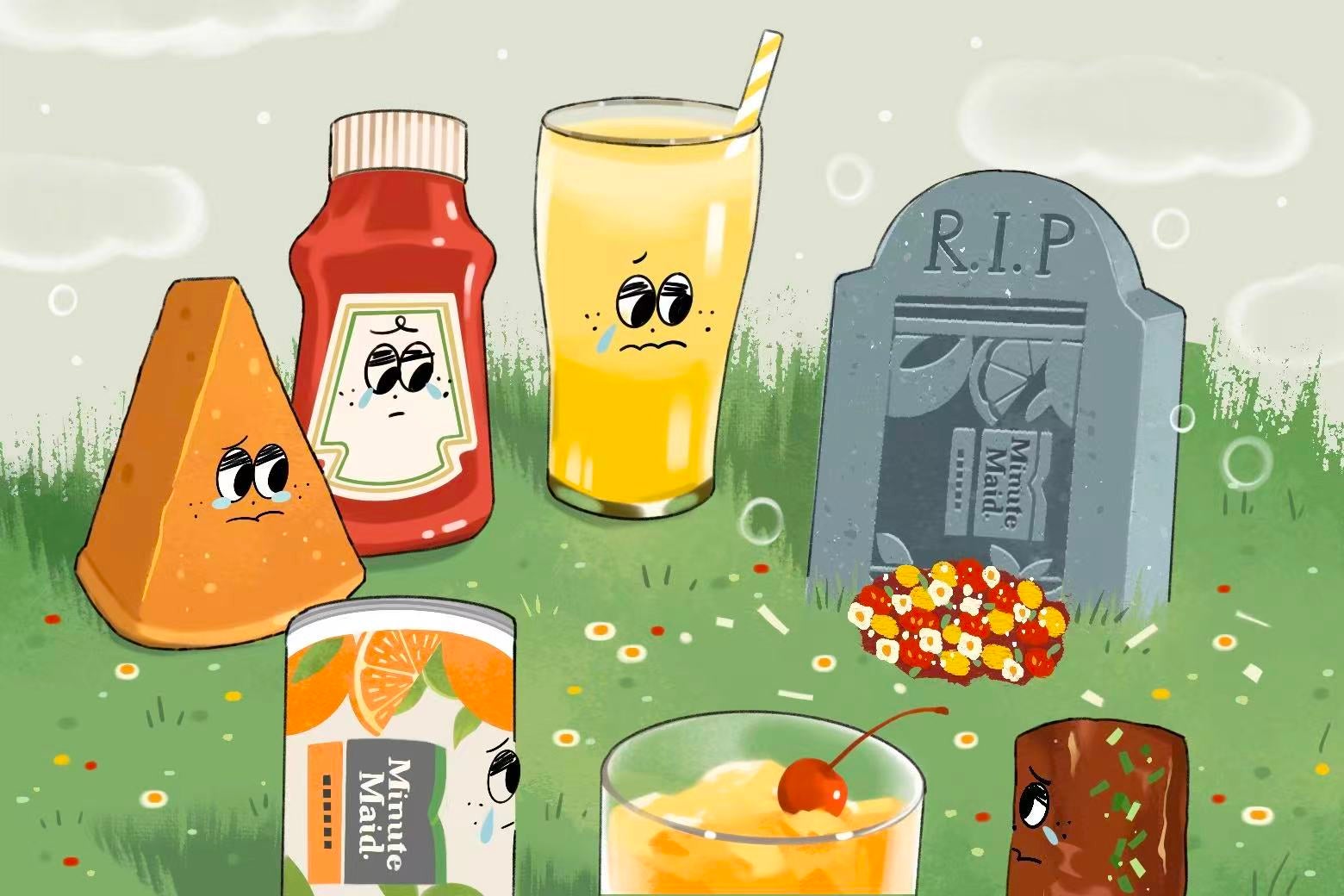
“Gone the way of the Jell-O salad,” an obituary might read. “Past its shelf life, at last,” another would lament. “Expired,” they’d all conclude.
Amid the chilled stock of Eggo waffles, Uncrustables, and Toaster Strudel, I pause my shopping cart before a stack of moribund cylinders. In the grocery store freezer aisle, I’ve come to pay my final respects to an iconic product. I open the freezer door and pick up a coil of spiral-wound paperboard. Somehow, its surface is tacky with sugar. Have the contents oozed through the packaging? Did it leave the factory coated in sweet residue? I don’t dwell on it as I load my cart with six of the 12-fluid-ounce cans of Minute Maid frozen orange juice concentrate. I’ll squirrel these away in my own freezer. Before long, I won’t be able to buy this item ever again.
Minute Maid, the first name in freezer-aisle juices since its launch in 1946, has finally announced the discontinuation of all its frozen juice products, which run the gamut of citrus colors and flavors, from country-style orange to puckery pink lemonade. After 80 years, the permafrost reliability of an American pantry icon has thawed. An era defined by concentrated orange juice—far more deeply than you might think—is hastening to an end.
Coca-Cola, which has owned the Minute Maid brand since its acquisition in 1960, announced in early February that its entire line of frozen juice concentrates would be out of production by April of this year. (Other private-label brands of frozen juice concentrates will remain on the market for the time being, but frozen juice is experiencing a systemic downturn. For its part, PepsiCo sold out of the juice category in 2021, off-loading Tropicana, Minute Maid’s chief competition since 1947, to a private equity firm.) But don’t blame Coke for capriciously putting a classic out to pasture. This one’s on us: Americans have turned away from frozen orange juice over the years for a variety of reasons.
At first, it was Tropicana’s 1954 innovation of flash pasteurization that allowed Americans to drink fresh, refrigerated juice instead of frozen concentrate, but Minute Maid remained cheap and popular for decades. In more recent years, consumer preferences for healthier, functional beverages have hurt demand for the processed orange extract. And perennially challenging environmental factors in the citrus hubs of Florida and Brazil have made the frozen cans far less affordable. According to data from the Federal Reserve, the cost of a 12-ounce can of frozen concentrate has more than doubled since January 2020, when a can cost about $2.32. Today that price has risen to around $4.86.
I’ve shelled out to stock up my freezer because the death of an ingredient necessarily has trickle-down effects in the culinary ecosystem. I’m attentive to the ripples of such a loss, to the cascades in my own personal food chain that will surely follow. There will be marinades that will lack a certain mid-century zing. There will be kitchen curiosities, like frozen orange-juice pie, left unsated. There will be shelf-stable shortcuts to piquancy and citrus obstructed. And perhaps worst of all for a drink-focused writer like myself, there will be vintage punches made more difficult, if not impossible, to resurrect.
You might accuse me of being melodramatic in eulogizing the most processed form of the humble orange. But I’d counter that you should read on. Very few products in the American pantry have skyrocketed to prominence as quickly as frozen orange juice concentrate did, and few innovations have become as ubiquitous on American tables and in American recipe books.
It is suitable that we owe the existence of this tropical delight to a Department of Agriculture research laboratory in Winter Haven, Florida. Thankfully, the citrus scientists of Winter Haven kept good records. Research chemist Steven Nagy’s 1977 classic Citrus Science and Technology Vol. 2 gives ready insight into the earliest days of OJ concentrate for those who are particularly fanatical about their citric and ascorbic acids. It was the harvest of the 1945–46 season that first resulted in the production of about 852,000 liters of the concentrate. British and American soldiers had received rations of a similar product during World War II, but it was tainted with the flavors of sulfur dioxide and benzoic acid used for sterilization.
The ingenuity of the postwar Floridians made frozen concentrated orange juice palatable to the masses via cutting-edge evaporators, which overconcentrated the juice to a higher Brix content (a measurement of dissolved sugars also used in wine). To save the flavor, they then added something called “cut-back,” a mix of normal orange juice with peel oil and other flavor essences that preserved the fresh, volatile flavor of the fruit. They froze the combination and put it up for sale. In 1948, U.S. Patent Number 2,453,109 was granted to citrus experts Louis MacDowell, Edwin Moore, and Cedric Atkins for their invention of the cut-back method.
The product’s success was instantaneous. American consumers had never seen orange juice like this before. In June 1945, the New York Times reported on the novelty of frozen OJ at a local grocer:
Up in Westchester County shoppers are carrying home oranges in a new way—not in bags or fiberboard boxes or market baskets but in small cans hardly larger than a cold cream jar. Each little tin holds six ounces of condensed, quick-frozen orange juice which, when mixed with the right proportions of water, provides twenty-four ounces of ordinary juice, or enough to fill six of the four-ounce cheese glasses that are used in many households at breakfast.
By 1948, American demand for the freezer juice had outpaced supply. Florida’s industry responded, building seven more concentrating facilities for the 1949 season, raising the total number to 10. California would start production in 1950.
John M. Fox, president of the Minute Maid Corporation, reported that 1949 sales were 300 percent higher than the 1948 level and that 40 percent of U.S. grocery stores carried the new commodity. Minute Maid sales amounted to just over $374,000 during their first year but grew to nearly $110 million by 1955. Fox, who brought on Bing Crosby as Minute Maid’s first spokesperson, would go on to put the famous individual blue stickers on the Chiquita banana after Coca-Cola acquired his company in 1960.
For millions of Americans during the following decades, these little, sticky cans were the quotidian source of a morning glass of juice. The Smithsonian recounts: “Many households adopted the habit of placing a frozen can of concentrate in the refrigerator to thaw overnight so that mixing it with water in the morning would be faster and easier.” It had become a universal daily ritual. The tubes would have been as recognizable as Campbell’s soup cans. By 1975, Florida was producing some 674 million liters of frozen concentrate, according to Nagy’s citrus tome.
Even Wall Street saw a lucrative opportunity in the Floridian innovation. In 1966 bankers began trading “futures in frozen orange juice.” The original contract still lives on as FCOJ-A, the world benchmark for the global frozen concentrated orange juice market. The contract, famously volatile due to the fickleness of citrus groves, figured prominently in the ending of the 1983 Eddie Murphy–Dan Aykroyd comedy Trading Places.
But my concern is not with who is losing money in the concentrated orange juice biz. It might be the Coca-Cola Company, a Wall Street trader, or a fixed-income shopper in the freezer aisle. I’m much more concerned with pumpkin pie, sparerib sauce, ketchup, bourbon slush, and sunshine punch. So many vintage cookbooks hold frozen OJ as a core ingredient. Just as the bankers saw it as a commodity, the American home cook saw it as a pantry staple.
I’ve leafed through many Junior League cookbooks from the 1970s and ’80s. I’ve perused some recipe books published as fundraisers by women’s groups at local Lutheran or Presbyterian churches. I’ve read the West Virginia Tailgater’s Club cookbook from 1984. All of them include frozen cans of orange juice as a key ingredient in all kinds of punches and drinks and sauces and marinades. But spiral-bound cookbooks and their constituent recipes have become as passé as the spiral-wound paperboard of the last Minute Maid cans stocked in the reach-in freezer. They’re both placeholders of bygone cravings. As their ingredients start to disappear, the recipes will increasingly become artifacts. Footnotes will need to be added to translate a forgotten format of OJ to a future chef hoping to re-create a dish. What was this “frozen concentrate” used for?
In some cases, it stars as a sweetener, in others a tenderizer. It can cool a punch while adding flavor. It can glaze an orange chicken. It can provide both the chill and the orange to a Frozen Creamsicle Pie. It serves as a shelf-stable citrus and a timeless tang. But that permanence is no more.
Sugar, coffee, cocoa. We trade these on the futures market, just as we surely have them shelved somewhere in the pantry. They are central to our lives and our recipes. At one point, this was the level of saturation that frozen orange juice concentrate possessed in the kitchen too. But as the downfall of Minute Maid shows us, things made to last sometimes last for only 80 years (what, you thought I was going to say a minute?) It’s only fitting to point out in an obituary that orange juice concentrate once started as a dehydrated dust back in the 1940s. It seems that the remaining cans are headed that way soon.
For you are dust, and to dust you shall return.
