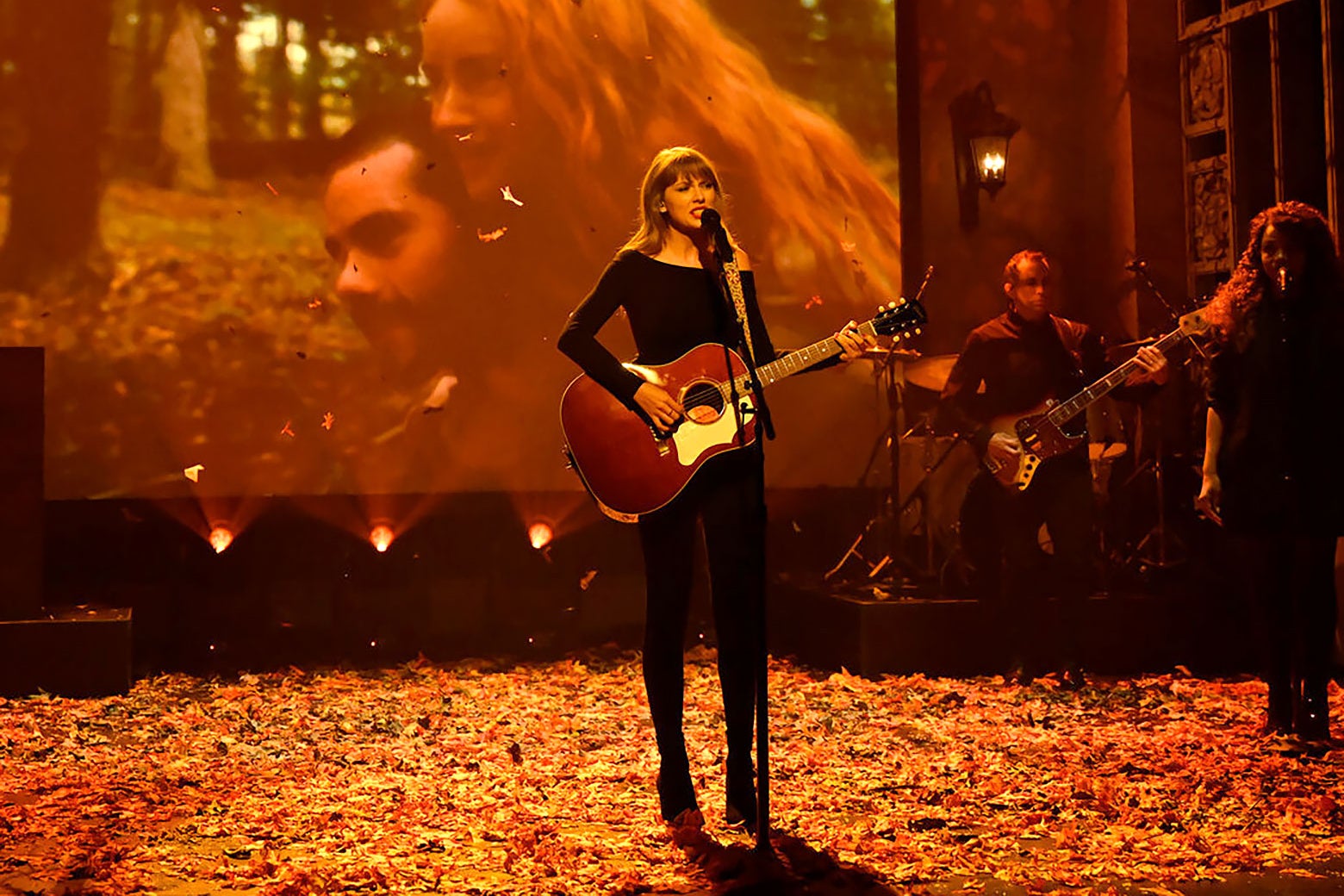
“All Too Well”—the 10-minute version, written years before but recorded only for Red (Taylor’s Version) in 2021—is Taylor Swift’s masterpiece, in the first, now obsolescent sense of masterpiece: the single work that demonstrates how a young creator (sculptor, painter, composer, etc.) has mastered the whole of her art. When I asked the students in my course “Taylor Swift and Her World” to nominate the single song that summed up her gifts, they seemed to agree. Most of her radio hits, beginning at “Our Song,” received multiple nominations. But “All Too Well (10 Minute Version)” proved the runaway winner, with more than 30 votes. (The runners-up got 15 and 14, respectively.) For her verbal powers, there’s no better place to dig in.
The 10-minute version—which Swift clearly wrote in 2012, along with the rest of Red—works as a masterpiece in part because it contradicts most people’s intuitions about how long pop songs can be. Many rock, funk, and R&B tracks last this long or longer, but they’re not constructed like pop songs; they’ve got multiple parts like classical music suites, lengthy instrumental passages and solos, or improvisational sections. Led Zeppelin’s eight-minute “Stairway to Heaven” has all three. Some neo-folk songs are this long too, but they repeat themselves, with musically identical verses and choruses and nothing in between, as in Bob Dylan’s almost nine-minute “Lily, Rosemary and the Jack of Hearts.”
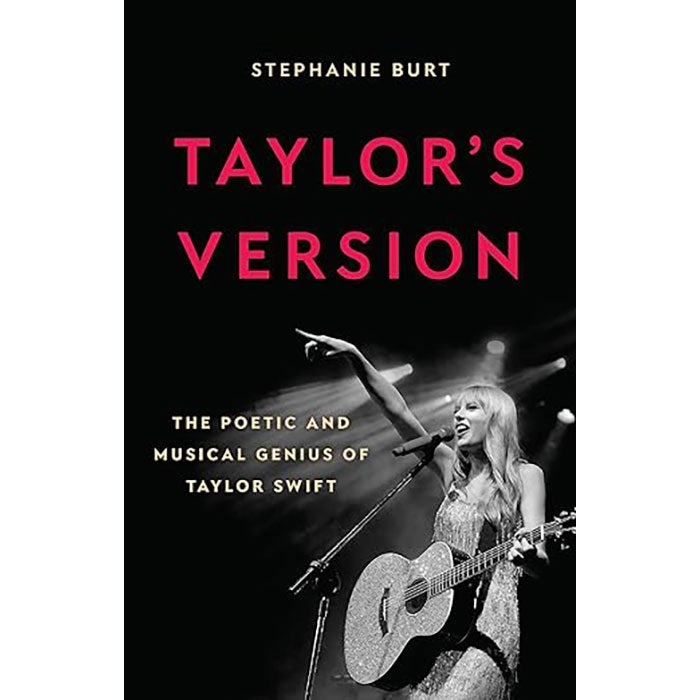
Taylor’s Version: The Poetic and Musical Genius of Taylor Swift
By Stephanie Burt. Basic Books.
Slate receives a commission when you purchase items using the links on this page. Thank you for your support.
“All Too Well (10 Minute Version)” does none of those things. Instead it stretches out a whole pop structure—verse, pre-chorus, chorus, bridges, instrumental interludes—until it justifies its 10-minute length. It’s not so much an alternative to the original as its fulfillment, the long and exciting drive from start to finish that the 2012 version should have become. The long version, like the short one, introduces the idyllic autumn start to a romance: opening a door, scenting the air, introducing the scarf.* Both versions set a seasonal scene, both outdoors and in-; both versions give us a house that felt like home (but wasn’t home), along with—of course—an automobile ride. Two minutes into the 10-minute version, we hear the first words not in the original: “And you were tossing me the car keys, ‘Fuck the patriarchy,’ / Key chain on the ground.” Swift gets aggressive, faster, about the competitive energy in this relationship, even when it was still going well. Would Big Machine Records have permitted Swift to say “Fuck the patriarchy” in 2012? None of her first three albums included swear words: This segment from the 10-minute version has no counterpart in the three-minute hit.
All these lyrics, new and old, intensify the sense that Red (2012) already gave—a romance defined by acceleration, movement, unpredictability, and an ultimately deceptive sense of breaking free, as well as by traveling in fast cars. The memory of those car rides dwells in her, has shaped her, still excites her, even though the romance has “long gone.” And it’s all red: the autumn leaves, the ex-boyfriend’s cheeks when he came in from the cold.* The song amounts to a masterpiece not just in how images move within the restricted space of a pop song, but also in rhyme and off-rhyme and consonance. Gaze, upstate, place, and days shift as if each word sought, but couldn’t quite settle into, its perfect rhyme. Asked for too much chimes with tore it all up; break me like a promise matches name of bein’ honest (notice the t’s in the first pair, the b’s in the second).
The 10-minute version piles on additional sonic effects. The “archy” in patriarchy half-rhymes with car keys. The “ain” in chain on the ground sets up an echo with the “ays” and the “in” in always skippin’ town. These devices might come off as not much more than basic competence in hip-hop, where rapid off-rhymes across lines are what we expect. In Swift’s kind of pop song, though, where everything has to fit a melody, and verse-chorus patterns aren’t optional, it’s bravura technique. It carries her anger forward too. That’s one way the song stays relatable: It’s as if we rode, with her, in the back of the car, as if we attended that ill-fated party.
Again, the original short version makes the emotional connection that Swift needs, but the extended version does it better, because it says more. It asks us to try on Swift’s points of view at several moments, times, and scenes—in the cold air, on the road, with a “MAPLE LATTE” (the hidden message in the 2012 lyric sheet), and then at his sister’s house, “in the refrigerator light,” then running the red light—through more full rhymes and vowel rhymes: gaze, upstate, place, days, same, grave, shame, frame. At the party, in the 10-minute version, Swift shifts to her dad’s point of view. “It’s supposed to be fun, turning 21,” he tells her, and that’s the moment we know the romance has crashed for good. What’s aspirational here? A parent who gives good advice. Would your dad say as much to you if your 21st birthday crashed and burned?
That moment in the 10-minute version about Swift’s 21st birthday also hooks back up to all the numbers elsewhere on the album—22 (years), eight (months), “4 a.m. the second day”—to tell us that we’ve got a coming of age gone wrong. “I’ll get older, but your lovers stay my age” echoes an infamous line from the 1993 film Dazed and Confused, where Matthew McConaughey’s character talks about dating teenagers: “That’s what I love about these high school girls, man. I get older. They stay the same age.” As the essayist Jill Filipovic writes, “Men who serially date significantly younger women are not looking for equal partners”; they’re “looking for someone who will admire them, who they can mold, and who will make them feel sophisticated and important.” That’s the dynamic that Swift rejects, both in “Dear John” and again in other postmortems on age-gap relationships, starting with “All Too Well” (even in its short version) and extending all the way to “The Manuscript,” from The Tortured Poets Department.
And that rejection means a lot. It’s a model for listeners, another way some of us might see ourselves in the songs. And it’s a shot across the bow (at the least) against all the elements in American culture that have encouraged grown men to chase teenage or nearly teenage girls. As of 2025, it’s not hard to find (once you look) pop songs by big-name artists about problematic, or predatory, older men. Yet almost all those songs, and all the hits, postdate “Dear John,” and postdate the first version of “All Too Well.” And most of them come from artists younger than Swift: Phoebe Bridgers (“Motion Sickness”), Demi Lovato (“29”), Billie Eilish (“Your Power”). “All Too Well” got there first.
The attention of “All Too Well (10 Minute Version)” to time’s passing makes both these songs not only romantic—that is, about romance and breakups—but also capital-R, lit crit–style Romantic. Time in nature normally moves in cycles. The leaves change, the snow in Brooklyn comes down, every year. We, however, get older. We cannot make the leaves or the years or the moments stay. And that contrast links Swift’s masterpiece to older masterpieces in other genres: for example, John Keats’ ode “To Autumn,” which ends with an orchestra’s worth of words for sound:
Where are the songs of spring? Ay, where are they
Think not of them, thou hast thy music too,—
While barred clouds bloom the soft-dying day,
And touch the stubble-plains with rosy hue;
Then in a wailful choir the small gnats mourn
Among the river sallows, borne aloft
Or sinking as the light wind lives or dies
And full-grown lambs loud bleat from hilly bourn;
Hedge-crickets sing; and now with treble soft
The red-breast whistles from a garden-croft;
And gathering swallows twitter in the skies.
“Full-grown lambs” are sheep, but newly so: like humans who have just turned 21. Helen Vendler says that “To Autumn” frames the passage of time against the limits of art, which cannot revive a life or a love: “The day dies, the season ends, the vistas end in horizons and skies, the fruits end in oozings.” Or in maple lattes.
I do not want to claim that Swift has read Vendler’s The Odes of John Keats, though she has probably read the odes of John Keats. Nor do I mean that “All Too Well” is somehow the equal (whatever that would mean) of “To Autumn”: poems for the page and songs with lyrics and music, in our time, are different entities, whose words do different things. I do mean, though, that the words and music of “All Too Well,” even in its three-minute iteration but especially in its extended version, echo Keats’ accomplishment. Swift’s move from autumn to winter, past the scarf and the red lights and the refrigerator glow, takes the willing listener on a musical and emotional journey not wholly unlike the reconciliation, the moving on, in Keats’ last ode.
Excerpted from Taylor’s Version: The Poetic and Musical Genius of Taylor Swift, by Stephanie Burt, copyright © 2025. Used with permission of Basic Books, a division of Hachette Book Group Inc.
Correction, Oct. 7, 2025: This excerpt originally misdescribed the scarf in the song as red. While it is red in the music video, in the lyrics it’s never given a color.