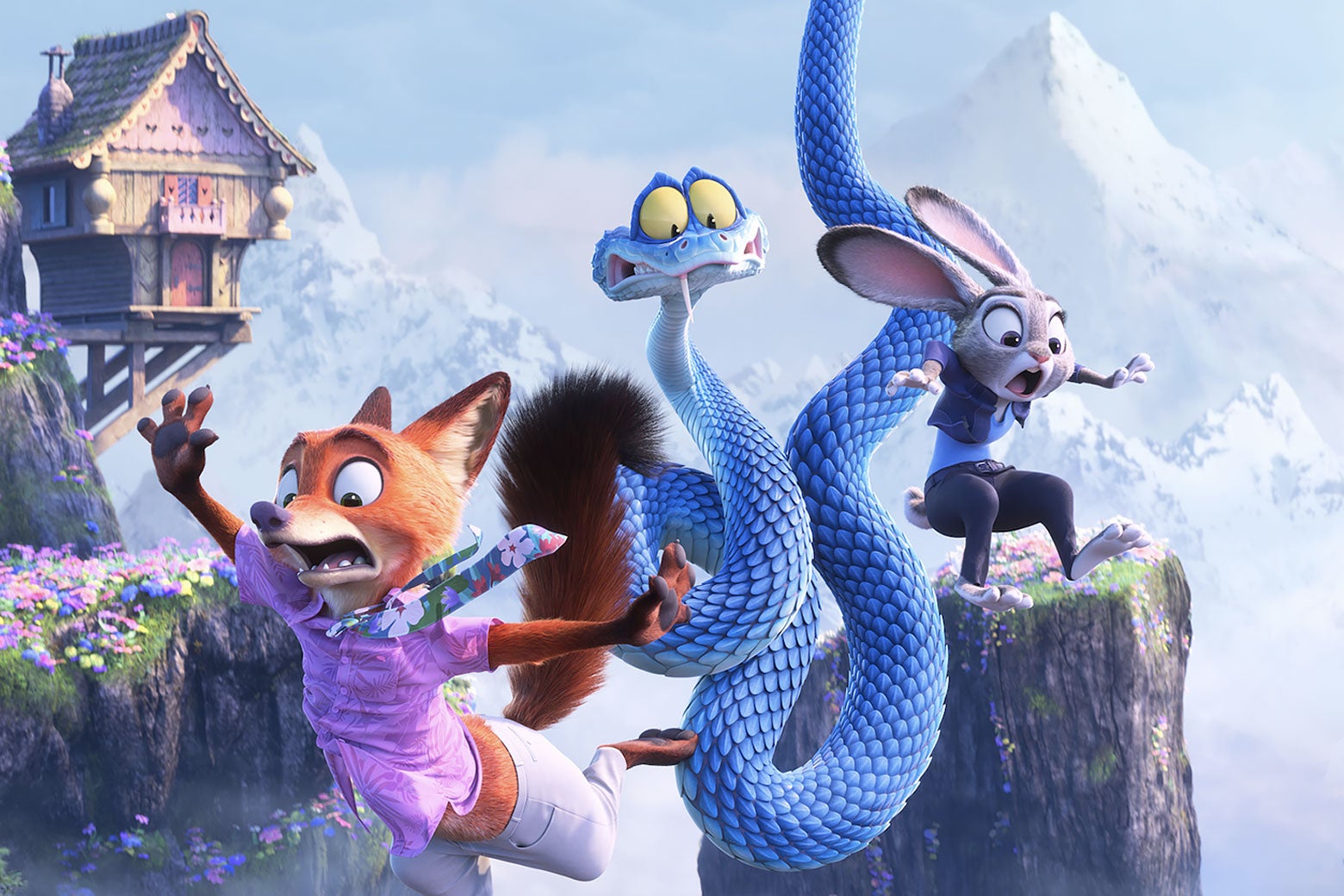
It has been nearly a decade since Disney released the animated film Zootopia, a movie that surprised people not only because it was a smash hit at the box office but because it also evoked a label that Disney (as a larger corporation) struggles with: “woke.” You might remember that the first movie, released in 2016 and set in the titular city of anthropomorphic animals, follows the bunny Judy Hopps (Ginnifer Goodwin), whose dreams of proving herself as Zootopia’s first bunny police officer are threatened when she teams up with a con-man fox, Nick Wilde (Jason Bateman), to uncover a far-reaching conspiracy. You might even better remember that the aforementioned conspiracy was basically an allegory for racial profiling—no, seriously—even if that allegory didn’t necessarily hold up if you thought about it for too long.
Now Disney has finally released their follow-up, Zootopia 2, and all eyes have been on whether the sequel would extend the first Zootopia’s shockingly mature admonishment about discrimination or retreat to safer, less politically charged territory. Well, not only is Zootopia 2 good (almost as good as its predecessor), but it’s also just as progressive. And this time, its flavor of social justice is … anti-colonialism?
After Judy and Nick, in the first film, save the day by overthrowing the previous mayor’s plot to slander and racially profile “predators” (which is to say lions, tigers, bears, etc.), the duo are ready for their next case. But their struggles to obey authority combined with their inability to work out the kinks in their partnership land them with a timeout and a summons to couples’ therapy for partners in the police force. Yet, despite orders to lay low, they find evidence of yet another massive conspiracy. Except this time, the conspiracy is more reminiscent of, uh, settler colonialism, and how it can lead to segregation and disenfranchisement. (Yes, this is still a kids’ movie.)
The story of Zootopia, we learn, goes something like this. The city was established 100 years ago by a lynx named Ebenezer Lynxley, who is credited with creating the weather walls that generate the various climates that allow the different animal species to live within the city’s boundaries. Before the city’s founding, reptiles lived in harmony with the other animals, in their neighborhood called Reptile Ravine. However, when a snake was declared guilty of fanging (thus, murdering) an innocent tortoise, all reptiles were painted as vicious and dangerous in the eyes of their fellow citizens. (Ah, there’s that specter of racial profiling once again.) So, reptiles were cast out of Zootopia, and one hasn’t been seen in the city for a century. Additionally, when Zootopia was inaugurated, it cut off a neighborhood now named Marsh Market—a commercial center built on boardwalks over a wetland, reminiscent of the bayous of the American South—which, due to its isolation, has become a haven for outlaws, outcasts, and the banished reptiles.
Naturally, Judy and Nick come across the first reptile to be seen in Zootopia in a century, a pit viper named Gary De’Snake (Ke Huy Quan)—yes, they do make good comedic use Gary’s last name—who tells them that not all is what it seems with Zootopia’s founding legend. Without spoiling too much, Judy and Nick call on their friends new—a beaver named Nibbles Maplestick (Fortune Feimster) who makes videos on a platform called EweTube—and old to help Gary unearth the hidden truth behind the unfair banishment of reptiles. What they find as explanation for the reptiles’ bad rap is a tactic straight out of the history books: convincing people that a certain demographic is dangerous and savage as a plot to steal their ideas and land.
Sure, much like the first Zootopia, this second chapter sometimes muddles its metaphor, and, perhaps blessedly, it may not have the rigor of a colonial studies course. There’s no real questioning of the system that kept the Lynxleys in power, and instead of being saddled with an evil mayor, Zootopia is saddled with something just as bad: a ditzy, former actor stallion (hilariously voiced by Patrick Warburton). Still, what Zootopia 2 does manage to convey is impressive—and certainly more successful than whatever Disney was trying to do with that reparations storyline in Frozen 2—and is, just like the first, a great conversation starter for parents to discuss difficult topics with their children.
And it does it all while maintaining the well-executed laughs and relationship development we’ve come to love from the first installment. Though Zootopia 2 is not quite as funny as the first, it’s still got a banger new song by Shakira and many rapid-fire gags, like a reference to the classic horror film The Shining, tons of Disney IP changed to punny animal titles, and a scene where the characters say “dik-dik” so many times you may begin to wonder if they have more in mind than the diminutive African antelope. And, while it doesn’t quite supply the same quantity of yuks, it overdelivers on heartwarming scenes. My entire theater uttered a simultaneous “aww” during a pivotal moment that shows Judy and Nick finally opening up to each other about their biggest insecurities, while Gary’s story certainly tugs on the heartstrings, too.
That the Zootopia franchise would stick to the kinds of evolved themes of the first film seemed perhaps impossible, given Disney’s recent utterly confusing politics, not to mention the national climate (though, it’s worth noting that the movie went into production long before the 2024 election). Since the first Zootopia, the company has been caught between the two sides of the culture wars. On one hand, Disney has been lambasted by liberals for allegedly cutting queer characters and subtexts from multiple projects, for rolling back corporate DEI efforts, and for suspending Jimmy Kimmel over a misguided but fairly innocent comment after Charlie Kirk’s assassination. Yet, they’ve also warred with Florida Gov. Ron DeSantis over his “Don’t Say Gay” bill (while still funding politicians who support it), and reinstated Kimmel, much to the chagrin of the MAGA fanatics who had called for his head.
At the end of the day, Disney’s motivations may be simply financial: Zootopia wound up raking in over $1 billion at the global box office, and Zootopia 2 is also on track to be a mammoth success, with a projected opening of as much as $270 million worldwide, which would be one of the biggest ever for an animated film. Still, while Disney may not be in the same place it was when it produced a full slate of inclusive hits in the mid-2010s, it’s good to know that the company still had the courage to show children the kind of fictional world that might help them fight for a better real one—so long as the price is right.