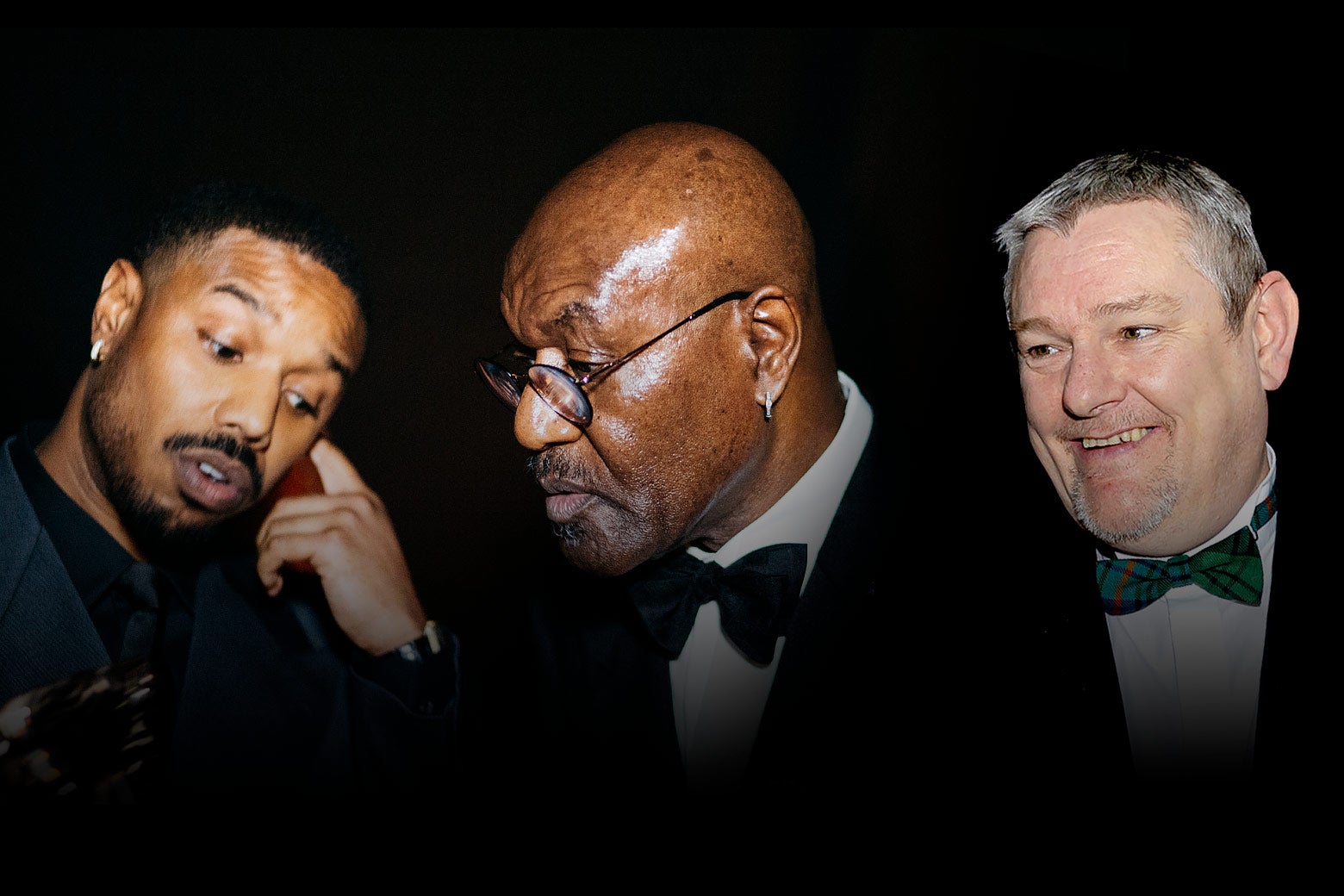
An incident at the BAFTAs this past weekend has had the internet ablaze in heated conversations about disabilities and racism. On Sunday, during the ceremony, John Davidson—an advocate for Tourette syndrome awareness and the real-life subject of the biographical film I Swear, which took home three awards that evening, including two for actor Robert Aramayo for his portrayal of Davidson—said a racial slur while two Black actors, Michael B. Jordan and Delroy Lindo, were onstage presenting an award. The moment was not edited out of the broadcast, despite the BBC taping the show on a two-hour delay. Instead, reports detail that host Alan Cumming issued a subsequent apology (the second of two times he reportedly stopped the broadcast to address Davidson’s tics that night) letting the audience know that there was a member in the audience with Tourette syndrome and apologizing “if you were offended.”
Since then, both the BBC and BAFTA have apologized, with the former alleging that the producers didn’t hear the slur from the media truck they were using to monitor the ceremony. For their part, BAFTA said that they “take full responsibility for putting our guests in a very difficult situation” and “apologise to all.” Davidson also released a statement, saying, in part: “I am, and always have been deeply mortified if anyone considers my involuntary tics to be intentional or to carry any meaning.” Notably, and much to the dissatisfaction of online critics, his statement carried no explicit apology. It did, however, mention that the producers warned the audience beforehand “that my tics are involuntary and are not a reflection of my personal beliefs” and that there was a “round of applause” that made Davidson feel “welcomed and understood in an environment that would normally be impossible” for him. Still, despite there being a pre-show announcement concerning Davidson’s tics, Lindo told Vanity Fair that he also wished “someone from BAFTA spoke to us afterward.”
In discussing what the proper recourse should be for incidents like this, conversations online have devolved into vitriolic ableism and racism, with Davidson’s critics saying he meant what he said and shouldn’t be able to get away with hurling a deeply charged racial slur at Black actors, regardless of his condition, and Davidson’s defenders saying that the nature of his disability means he has zero control over his tics, and they should be taken as divorced from their meaning. Overall, there has been little room for nuance in between. In order to wade through this mess, I spoke with Jhónelle Bean, a Black woman with Tourette syndrome, whom I was connected to through the Tourette Association of America. Bean, a disability advocate and ASL interpreter, has been working in the disability community for about 11 years and has been an advocate for more than four. This conversation has been edited and condensed for clarity.
Slate: The biggest question or assumption that I’ve been seeing online is people saying that John Davidson would only have said the N-word as a tic if he himself were racist. Is that how having tics works?
Jhónelle Bean: No, not at all. Tourette syndrome is a complex condition. Typically you have motor tics, which are movement, and vocal tics, which are sounds. About 10 to 15 percent of people with Tourette syndrome have coprolalia, which is an even more complex tic that makes you say things that are either socially inappropriate, culturally inappropriate, or obscene. So in order for you to think those things are inappropriate or obscene typically means that it is not part of your daily vocabulary or your belief system.
With coprolalia, depending on the situation that you’re in, there might be different triggers. For example, if someone is in an airport, their trigger might not be to say the N-word, but it might be to say that they have a weapon when they don’t because, in that context, that’s the most obscene thing that you could say or that could happen. That type of tic is a lot more complex in terms of identifying that this would be the worst thing to say in this moment, but it does not mean that because he said it, he’s racist. In fact, I’ve seen him in interviews before talking about how awful he feels in terms of having that tic because, again, it does not match with who he feels he is as a person or what he believes.
So no, that is the No. 1 myth I’d like to dispel. It does not mean that because he said it, he’s racist. It does not mean that it is in his everyday vocabulary. There are tons of words that we know, tons of derogatory words that you might’ve heard. That doesn’t mean that it’s part of your everyday vocabulary.
Just for clarity, is the actual impulse of the tic to say whatever the worst possible thing could be at that moment?
Yes. And there are different triggers. I’ve also seen a lot of people say, Well, how come he only said the N-word when Black people were onstage? Why didn’t he say anything else? One, we don’t know that he didn’t because, again, it’s edited—which we can get into later. But, just like how sneezes come out at different levels, tics can come out with different intensities.
Oftentimes, as a person with Tourette syndrome myself, friends that I have that have Tourette’s might do what people that were there have said Davidson did, which is to get up to leave. Sometimes we try our best to hold in tics but it’s not very successful, so sometimes we’ll go somewhere else to let tics out. He said other offensive things that night, it’s just that this was the one that the BBC decided to keep in their edit.
How do tics and triggers develop? Could it be because of a movie you watch or an association that you see other people making, and then you just happen to make it yourself? I ask because there’s a lot of speculation as to why that word would be in Davidson’s “vocabulary.”
Coprolalia is kind of situational. My vocal tics are more so like sounds, my condition’s a bit more mild to moderate. But, for my friends who have more complex conditions, their tics might be something that they’ve heard. Maybe it’s the tone in which somebody said something that sounded funny, they might copy them. That is another complex tic called echolalia. The brain is a funny thing. I have a friend that used to work at Texas Roadhouse and the whole “Hey everybody, we have a birthday” script they’re supposed to memorize became a tic for her. And even though she no longer works there, she still says it. So, it really can be anything that you see or that you hear. Sometimes they really are just random. Sometimes it really is just “coffee!” and now this person is saying “coffee!” even though they don’t drink coffee and nobody near them has had coffee.
OK, let’s follow this online discourse. So, someone will say, “That’s racist!”, and then someone will reply, “No, it’s not.” And then the retort will be, “Well, if it’s so uncontrollable, Davidson should have been backstage or he shouldn’t have been invited or he should have stayed home.” What do you say to people who think that?
There are two ways that I want to address this. First, in terms of people saying that he should have been backstage or that he should have been separated from everybody else because of his Tourette syndrome—even though he was there promoting his movie on Tourette syndrome and acceptance—that’s us taking a step back. That’s us regressing. There used to be laws in the United States called the “ugly laws” that mandated that people with disabilities couldn’t be in public at a certain time period. Typically this was more for physical disabilities, hence the name, because the belief was that other people shouldn’t be subjected to seeing disabled people who look different. They thought that disabled people, including maybe people with invisible disabilities or other types of disabilities, needed to be locked away.
Having that as the expectation of what John Davidson needs to do for the sake of other people, I think, is very dehumanizing. There are times where, in schools, people with Tourette’s might have an accommodation to test in a different room, but that’s more so that they can concentrate because, again, when you are in that space and you’re ticcing and you notice other people looking at you ticcing, you can’t focus on your own test. But I don’t think that that should just be applied to every area of life. Unfortunately, people do get kicked out of movie theaters. People do get kicked out of restaurants because of that.
Where I feel the racism lies, and I keep bringing it back because that’s where my anger lies, is the BBC editing team choosing to keep that incident in. They decided to edit out other things in terms of some of his tics and other things that were considered free speech. But somehow that made the cut. That’s where the intention lies and that’s where the harm lies, because now this has affected the disability community. I’ve seen, online, people threatening him. Other people with Tourette syndrome and coprolalia are getting threats as well because of it. It’s incredibly harmful to the disability community.
And, as someone who has the intersectionality of both communities, it’s also incredibly harmful to the Black community because now there are a ton of racist people just being blatant and saying, OK, yeah, well, if that guy can say it and it’s not a problem, then I can say it and I can just pretend I have Tourette’s. And so now there are Black people that are being harmed in another way because of that. And all of that could have been avoided if they didn’t keep that in the edit.
The BBC aired the ceremony on a two-hour tape delay. This moment was not edited out or muted or censored and this version of the broadcast was also left up on BBC’s iPlayer on Monday morning before being removed. However, they did edit out some of Davidson’s other tics and, notably, a part of Nigerian-British director Akinola Davies Jr.’s acceptance speech for his film My Father’s Shadow, when he said, “Free Palestine.” During the broadcast, after the incident, host Alan Cumming referred to “some strong and offensive language” and added: “We apologize if you were offended.” The BBC and the BAFTAs also apologized.
I don’t know necessarily if Alan Cumming was reading from a teleprompter, so if he was, obviously this would be because of the BAFTAs, but even that apology of, “Sorry if you were offended,” is not a real apology. It’s a bit passive-aggressive because both can be true at the same time in terms of John having Tourette syndrome and him ticcing and it being involuntary and unintentional, but also intentionality does not negate the fact that it could be harmful and hurtful for people to have heard that. And holding space for both is fine. Again, I am literally both. I get it. Which is why I’m staying on BAFTA’s and the BBC’s necks because they chose to keep that in and it caused a lot more harm.
Do you feel that there’s enough accountability being taken?
Honestly, I don’t think I can sit here and say, “Yes, that suffices,” because there’s still a lack of them answering as to why it was included in the first place. That’s where my anger lies, because how are you picking and choosing, Yeah, we’re going to take out this person’s message about Palestine, but this was an embarrassing moment and dehumanizing moment to different groups and we’re going to keep that in? Now you realize that it’s bad because you’re getting backlash. It’s giving “sorry they got caught,” not “sorry that it happened.”
If we’re following the discussions, a lot of the conversations culminate in this point where people realize, OK, people with disabilities deserve to be in these spaces and they deserve to be visible, but also their disabilities can cause them to do or say harmful things to other demographics, and those people don’t deserve to hear those harmful things. It feels like people are at sort of an impasse there. So what can we do here? From your point of view, is there even a solution, or is the solution to just hold grace for this moment that happened and to understand that these two things can sometimes be in friction?
I think the duality of the situation is important. Unfortunately, I feel like social media is not the place that’s going to hold the duality for both, because it’s not enough to just simply say, “Oh, well he has a disability,” and explain it away, and tell people, “Stop, he’s fine, it’s fine. Don’t be offended.” Black people have been policed into being offended about something or not offended and being told what they can or cannot make a big deal about. That’s not what is needed in the conversation either. But it’s also not just, “Well, he said that and that’s a racist word, which means he’s racist, period.” Now, you’re either ableist or racist in not being considerate of Black people’s feelings—but you can hold space for both. I don’t necessarily think social media is the place where people are going to willingly do that. For example, I posted a video about my thoughts last night on it, and the average watch time was about 40 seconds, which is before I even explained my first point when dispelling some misconceptions.
But if there’s somebody that’s really out there wanting to figure out, What do I do with this conflicting information? What is the solution? The only thing I can keep pointing back to, in terms of it causing harm to both communities, is look at how all of that could have been avoided if they didn’t leave it in the edit. And that’s why I keep pointing back to that in terms of intentionality and harm. I just think it’s one of those uncomfortable things in terms of newly understanding Tourette syndrome or understanding, Hey, yeah, we do have to validate Black people’s experiences and understand that even though it wasn’t intentional, it could still cause harm.
I think a lot of people’s personal discomfort extends to a hypothetical, which is: It’s not just about the broadcast. If you are one of those actors on stage, or if you were in that room, or if you were in a different room that isn’t being broadcast internationally, and someone with Tourette’s says something really offensive to you, is there something that can be done about that or is there even something that should be done about that?
I’ve also seen a lot of people saying that they feel like an apology needs to be demanded by John, and to each their own. But I wasn’t there. You weren’t there. To my knowledge, everybody who’s saying that wasn’t there. To my knowledge, we don’t know if he apologized. I have heard from some people that claim that they were there that he was profusely apologizing to people around him. I don’t necessarily know if he got to speak with Michael B. Jordan or Delroy Lindo after. I do know that BAFTA didn’t approach them after to apologize or say anything aside from the comment on stage of “sorry if you were offended.” And that’s it. So, in terms of apology, it really should be coming from the people who had the power to do so and chose not to.
I think you used a really great word there when you said a lot of people’s concerns are in hypothetical situations. What are hypothetical situations for you all are real-life situations for people with Tourette syndrome and coprolalia. I have plenty of friends with Tourette syndrome that have coprolalia and will speak with each other after they’ve had an incident where they were out and about and a specific slur or curse word was triggered. Sometimes it’s not even a slur, it might be that they’re around kids and they feel like they want to curse and then they’re like, Ooh, I can’t. And now parents are mad at me and now people are yelling at me in my face and harassing me. Obviously, in those cases, again, it’s a duality thing. Yes, the parents could be offended that their kid heard a new word and now the kid knows the word and they’re going to hear it for the next two weeks—but, also, to have an understanding that it is uncontrollable.
The best example or parallel I can give for people to understand, because everybody experienced this during the pandemic, is when you have to cough. I’m sure there might’ve been an experience or a time where you’re like, Ooh, I really got to cough, but if I keep coughing, people will think I have COVID. And then the more you hold it in, the more your eyes start to water, you start feeling really uncomfortable, and it comes out in a coughing fit. Would I sit there and say that, Oh, because you might have to cough and people might think that you have COVID that you need to just not be out and about? No, not at all.
But I have a lot of friends with coprolalia, and they do talk about how hard it is. They understand why people are offended. It’s just a hard thing where both are valid. But I think it can cross the line when the person who’s being hurt by the tic now wants to hurt the other person physically, which is not a hypothetical. You can be upset, and you might want to move and not be at the restaurant, and that’s completely understandable. That’s your right. But it’s never OK to then take that and turn around and intentionally harm the person who unintentionally harmed you.
I 100 percent understand feeling like an apology is owed, but I also understand that it must feel really awful to have this great moment in your life where your disability is being recognized and there’s this award-winning movie about it that you’re celebrating, and you have to spend that whole night apologizing to other people.
Not even just that night, but that is just life for individuals with coprolalia, constantly apologizing and constantly feeling shame because of it. If they edited it out, obviously the harm to Michael B. Jordan, Delroy Lindo, and whoever else might’ve been in the room would still be there, but it would’ve stayed in the room. Now it’s causing more harm.
And it doesn’t just happen to random people, to strangers. It happens to friends, too. I’ve had my friends with Tourette’s call me the N-word or try their best to not, but obviously it’s a tic. They’ll sit there and profusely say sorry and get upset over it. I’m at the intersectionality of both, I get it. But what type of cognitive dissonance do they live with every single day to not be able to control that?
As a Black person with Tourette syndrome, do you feel like a part of this conversation is not taking into consideration that there are also Black people with Tourette syndrome?
I didn’t necessarily think about it erasing me as a Black person with Tourette syndrome. I just think, again, it is not taking into consideration the intersectionality of it all. There are times when, if I’m ticcing or doing something, because of the color of my skin, people will already assume different things about me. For example, a very simple tic I have might be to move my eyes. And people have claimed that I’m having an attitude. Where did the attitude come from? I’m fine, but I’m Black, so you think I have an attitude. Or, I would get really nervous as a Black person around law enforcement, but I get extra nervous if I know that I’m having a more tic-y day because, are they going to sit there and take a moment to assume that maybe it’s involuntary? My experience as a Black woman with Tourette syndrome is vastly different from that of a white person with Tourette syndrome.