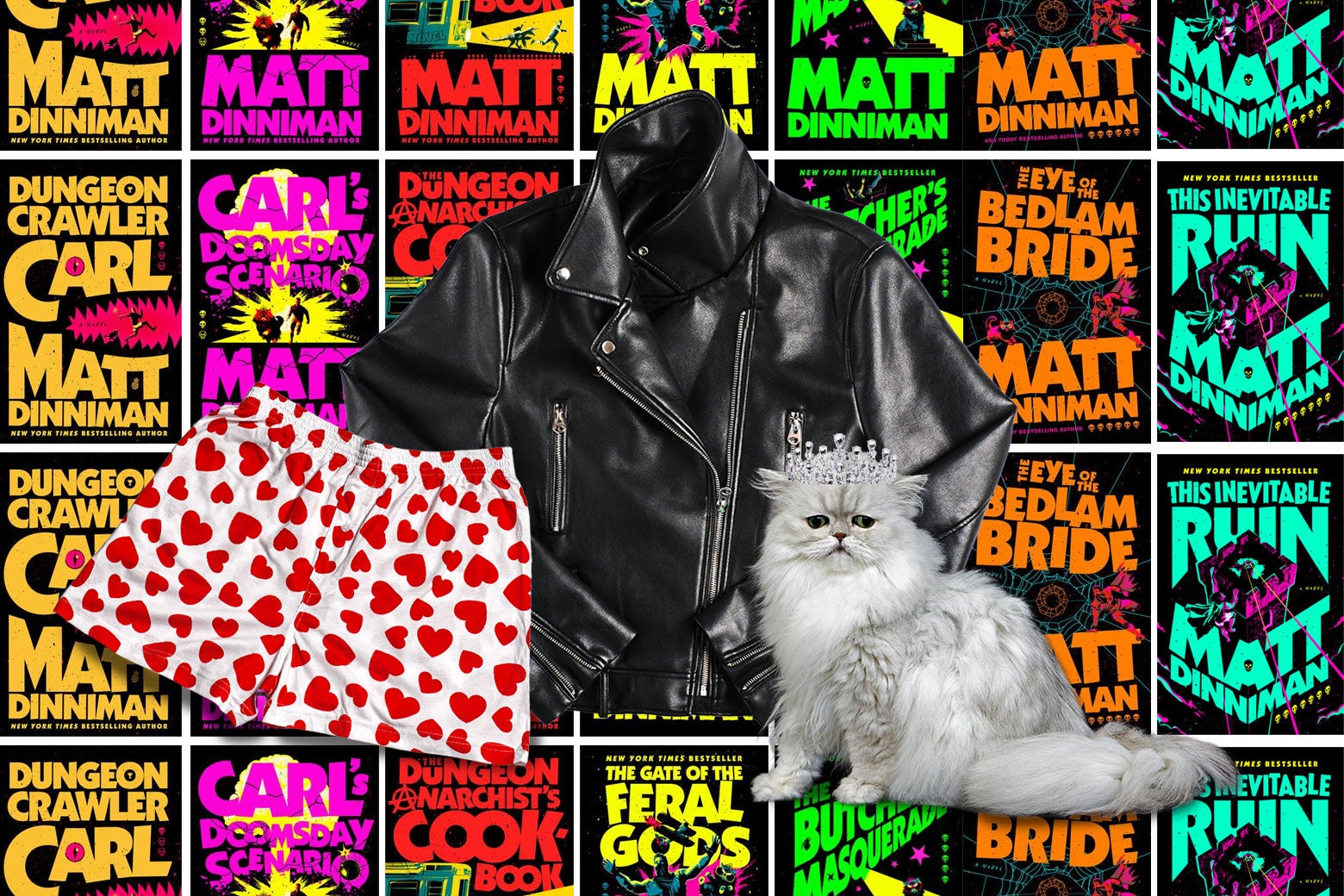
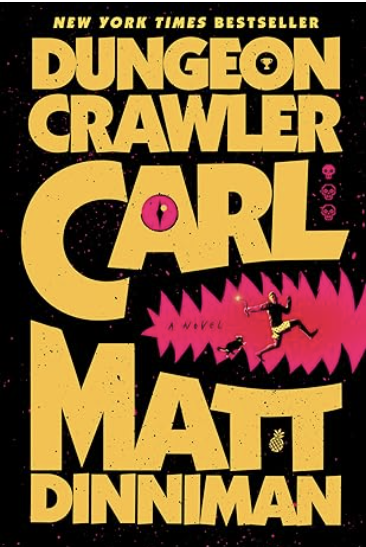
If you’ve asked for a book recommendation lately, chances are you’ve been buttonholed by some goggle-eyed person babbling about boxer shorts, dungeon levels, and a tiara-wearing Persian show cat named Princess Donut. These are the Dungeon Crawler Carl fans, devotees of a series of seven novels written by Matt Dinniman (with the eighth to publish in May), and their ranks appear to be growing exponentially. The series has been optioned for a TV adaptation by NBCUniversal and sold more than 6 million copies, and the New York Times has marveled over the “gonzo” enthusiasm of fans who show up to Dinniman’s public appearances dressed as everything from a well-armed Jesus to a fanged, severed sex-doll head. But what exactly, you may still be wondering, are these books really like?
Dungeon Crawler Carl and its sequels are examples of a genre called LitRPG, fiction that combines action-adventure storytelling with the mechanics of video and tabletop role-playing games. If that sounds extremely and alienatingly geeky to you, consider the testimony of New York Times reader Janiece Mulia, who posted a comment explaining that her son “forced” her to listen to an audiobook of Dungeon Crawler Carl during a long car trip. “I know nothing about playing video games (I’m 68),” Mulia wrote, “so I thought I’d humor him for an hour or so. I now own all 7 books, digital and audio, plus I’m a paying member of Matt’s Patreon. I can’t remember being so engaged by a book series.”
For the uninitiated, a dungeon crawler is a game in which the player progresses through a series of contained and increasingly difficult levels by defeating enemies, solving puzzles, and gathering loot. Carl, the narrator of Dinniman’s series, finds himself plunged into a real-life version of such a game after aliens wipe out most of Earth’s population and repurpose the planet into a massive game dungeon, forcing the survivors to fight their way through it for the amusement of an intergalactic television audience of trillions. At the time of the invasion, Carl, a U.S. Coast Guard veteran, was standing outside his Seattle home in the middle of the night, trying to coax his ex-girlfriend’s cat, Princess Donut, out of a tree, and wearing only heart-patterned boxer shorts and a leather jacket. Over the course of the series, Donut will acquire the ability to talk, reason, and shoot deadly laser missiles from her eyes, but Carl will never get shoes or trousers.
There’s more than a touch of The Hunger Games in Dinniman’s series, specifically in the harsh contrast between the desperate straits of the human crawlers—Carl regularly notes the dwindling number of survivors as the remnants of humanity are killed off by the game’s monsters and catastrophes—and the bubbly way the spectacle is portrayed by the alien media. Carl and Donut eventually become celebrities of a sort, to the vain Donut’s delight and Carl’s exasperation. Like the contestants in The Hunger Games, the crawlers must cater to their audience in hopes of receiving gifts that will enhance their ability to survive.
But where The Hunger Games is somber, Dungeon Crawler Carl is funny. The series’ humor ranges from the absurd to the sophomoric, but the underlying tone throughout is a dark resignation, that working-class mordancy adopted by the world’s underlings as they struggle to maintain their dignity while being exploited by indifferent elites. The game is managed by a wayward A.I. that pops in to announce the crawlers’ achievements and rewards or to describe the enemies and tasks confronting them. One long-running joke has the A.I. arranging for Carl to remain shoeless because it has a foot fetish. The gifts sent to the crawlers by fans can be helpful, but just as often trollish, as when Donut, to Carl’s dismay, receives a photo of herself with “Miss Beatrice,” her owner and Carl’s cheating ex.
Surely these gifts and other aspects of the game interface must be the most disorienting aspect of the novel for non-gamers. The gifts appear in boxes that only the recipient can see, and they include wearable items, potions, and spells that bestow special powers or upgrade the crawler’s skills. In role-playing games, a player typically creates a character by choosing a race (human, elf, dwarf, etc.) and a class (warrior, healer, mage, etc.), each with abilities quantified by number. Carl starts out with a base Strength of 6, which he is able to raise by equipping himself with such items as the Enchanted War Gauntlet of the Exalted Grull. (Yes, the item names are meant to be silly parodies of the typical high-fantasy RPG gear.) His Constitution is 5. Princess Donut is more fragile, while her Intelligence and Dexterity are higher, but her most advanced skill, at a whopping 25, is her Charisma, which enables her to charm NPCs (non-playable characters) like tavern owners and shopkeepers into dispensing special privileges.
Carl, Donut, and the series’ other crawlers spend a lot of time grinding away to get their skills up, earning experience points by killing monsters, casting spells, and engaging in other forms of gameplay. Vanquishing the more formidable creatures, the area bosses, wins them especially desirable prizes and bigger stat upgrades. Crawlers can be grievously injured, and then swiftly healed by drinking a potion, and they can read another player’s overall level, health, and stats just by examining them. All of this will be familiar to anyone who plays video games, and yet isn’t, it seems, enough to put off many of the non-gamers who have been persuaded to give the series a try.
Dinniman began writing Dungeon Crawler Carl while working a lucrative day job that wouldn’t be out of place as the backstory for one of his characters: traveling to cat shows and selling drawings of the felines to their doting owners. (This was where he encountered the tortoiseshell who inspired Princess Donut.) He posted the story in installments to Royal Road, a platform for web serials, and the series still exhibits the ungainliness of the serial form. The Dungeon Crawler Carl books are unusually long for adventure novels, with the seventh and most recent title, This Inevitable Ruin, clocking in at a mammoth 881 pages in hardcover. But most of Dinniman’s early readers encountered Carl and company on screens rather than pages. When the pandemic shut down the cat show circuit, Dinniman began selling his Carl books in Amazon’s Kindle store, and started a Patreon, which now has about 15,000 paid members.
The Dungeon Crawler Carl series found its ideal form, however, in audio, the format that, according to Dinniman himself, outsells both print and e-book combined. This is due largely to the preternatural talent and range of narrator Jeff Hays, who has created distinct voice profiles for the series’ scores of characters and who commands nearly as much reverence from fans as Dinniman does. (You can see a snippet of Hays’ talent on display here.) Since the human crawlers are able to choose new races on the dungeon’s third floor, those voices include not just men, women, and children (and cats), but also humanoid goats, people made of rock and lava, gnomes, fairies, demigods, and other imaginary beings. Apart from the occasional guest cameo, the Dungeon Crawler Carl audiobooks are single-narrator productions that sound, astonishingly, like the work of a full cast.
The audiobook form also serves the multifarious nature of the series; it has something for everyone, from adventure to humor to horror to sociopolitical commentary. Some readers surely most enjoy Dinniman’s long action sequences, or his detailed descriptions of the various contraptions and devices that Carl designs to thwart the crawlers’ enemies. I, however, find these sections difficult to visualize, especially the famously confusing “Iron Tangle” in the third book, The Dungeon Anarchist’s Cookbook, set in a level that consists entirely of subway trains. (Dinniman himself included an author’s note saying readers needn’t struggle to comprehend this puzzle if it’s not to their taste, but I’d bet there are engineering-minded fans who adore it.) Listening to the audiobook while, say, washing the dishes, I gently zoned out during these passages, tuning back in when the narrative returned to character interactions or the larger powers at work beyond the game itself.
Slate receives a commission when you purchase items using the links on this page. Thank you for your support.
Poking around the internet to explore other readers’ takes on the series, I was struck by how many people describe Dungeon Crawler Carl as a “fun ride” or “popcorn,” when what ended up hooking me is the way the characters of Carl, Donut, and the companions they acquire as they go, deepen. Carl never loses touch with the atrocity inflicted on humanity, and gradually develops as a leader (pointedly, not one of the skills included in his stats). Donut, while delightfully spoiled and a spotlight addict, shows herself to be fiercely loyal and a surprisingly good judge of character. Things that never cross the mind of an actual video game player—such as what it’s like to be an NPC—eventually become significant and tragic themes. Last but far from least, the crawlers’ exploitation at the hands of a heartless entertainment industry, and the corporate skullduggery behind the scenes, become an increasingly rich and pointed analogy to the power imbalances of our own world. The books that at first appear to be a frothy, funny tribute to gaming end up scrutinizing the cruelty at the root of so much humor and the perils of treating real life like a game. When it came time to pick a race, Dinniman and Dungeon Crawler Carl decided he would continue to appear as a human, and that’s what this series has blossomed into, something profoundly and endearingly human.*
Correction, Feb. 7, 2026: This article originally suggested that Carl chooses to remain a Human. Technically, he chooses to become a Primal, a race that allows him to continue appearing human.