When it was first revealed that Puerto Rican superstar Bad Bunny would be headlining the 2026 Super Bowl halftime show, it was immediately registered as a political choice. The singer and rapper—who captured hearts around the world last year with his smash-hit sixth solo studio album, Debí Tirar Más Fotos, sung entirely in Spanish—had been in the middle of a world tour. Controversially, Bad Bunny deliberately chose to bypass the 50 states of the U.S. in favor of international dates and a massive 31-show Puerto Rican residency, all for fear that Immigration and Customs Enforcement would target concertgoers. There was one exception to this: the Super Bowl, which Bad Bunny announced with a singular tweet: “I’ve been thinking about it these days, and after discussing it with my team, I think I’ll do just one date in the United States.”
Conservatives’ anger was ugly and immediate. Donald Trump remarked that the NFL’s choice in performer was “absolutely ridiculous,” while Department of Homeland Security Secretary Kristi Noem threatened that ICE agents would be “all over” the game, which was to be held in Santa Clara, California, a state that has one of the country’s highest populations of immigrants without permanent legal status. (During game week, though, both the NFL and California Gov. Gavin Newsom revealed that they were assured ICE wouldn’t have a presence at the game.) Right-wing ire only grew after last week’s Grammy Awards, when, against the backdrop of ICE’s activity escalating in nearly every manner possible, Bad Bunny won three awards—including Best Música Urbana Album, Global Music Performance, and a historic Album of the Year—and said, “Before I say thanks to God, I’m going to say ICE out,” continuing his speech with a now-viral statement: “We’re not savage, we’re not animals, we’re not aliens. We are humans and we are Americans.” True to form, Trump called the award show “virtually unwatchable.”
Quickly, the question became: What would Bad Bunny, one of the most popular artists across the globe, do with his spotlight during America’s most-watched televised event? Would he provide subtitles for the large swath of viewers who don’t speak Spanish? Would he decide to make a pointed political statement like Kendrick Lamar did the year prior? Maybe he would do a mixture of both politics and pure fun, like Jennifer Lopez did while performing with Shakira—and Bad Bunny as a guest performer—in 2020, when she wore a reversible Puerto Rican and American flag cape, and featured kids in cages. Fans and naysayers alike were working themselves up imagining fire and brimstone; the president himself announced that he wouldn’t be watching, in protest.
But, as we all bore witness to on Sunday night, Bad Bunny did none of that. Instead, he applied one of the greatest lessons you learn as a part of an oppressed group: Joy is resistance. Pride in your heritage is protest. Being unapologetic about it all is radical. Instead of making an explicit anti-ICE political statement like he did on the Grammys stage, Bad Bunny chose to revel in the beauty of his culture, knowing that that in itself would be politically meaningful enough. Naturally, this meant he did it without a single subtitle for non-Spanish-speaking audiences—and thank God.
Bad Bunny’s unabashedly Latin performance opened with one man saying, as translated by the New York Times: “How great it is to be Latino. Tonight, we drink.” This transitioned to one of the most intricate sets the Super Bowl halftime stage has ever seen: A large sugarcane field was created on the gridiron, peppered with various Caribbean references as the artist walked through it. Wearing a white football jersey with his surname, Ocasio, on the back and the number 64 on the front, Bad Bunny opened with “Tití Me Preguntó” as he meandered past sugarcane workers in the field. Continuing his song, he passed a guy selling coconuts, a group of older gentlemen playing dominoes, a nail technician, a man and his piragua cart, two boxers duking it out, a taco truck, a gold jewelry seller, and more iconography quintessential to Puerto Rico. He continued his performance over a replica of a house party (apparently a replica of a set, “La Casita,” he used during his tour) whose porch was also dotted with a smattering of notable names—Pedro Pascal, Jessica Alba, Young Miko, Karol G, Alix Earle, Cardi B—shown so quickly that you would’ve missed their cameos if you blinked. He made a surprise drop into the casita, which was decorated in exquisite detail like a traditional Christian Puerto Rican home. In delightful contrast, his next sojourn outside the house was to a crowded pit of writhing, grinding dancers perreando—appropriate, for a set that included “Yo Perreo Sola” earlier—before a brief but important interlude shouting out Puerto Rican reggaeton legend Daddy Yankee’s hit “Gasolina” led into his next song, “Eoo.”
For the masses not from the Caribbean or without a Latin background, the most familiar cultural touchstone of the show was Lady Gaga, who performed a salsa version of her hit “Die With a Smile,” originally performed with Bruno Mars. Then Bad Bunny jumped into the tracks “Baile Inolvidable” and “Nuevayol,” which was performed in front of a facade of a marqueta, or convenience store, complete with such small details as a “We accept EBT” sign. Ricky Martin came out and sang “Lo Que Le Pasó a Hawaii” (itself a protest song of sorts) in one of the two white plastic chairs memorialized on the DtMF album cover—iconography that both serves as an ode to Caribbean social life and signifies the forced emigration of Puerto Ricans.
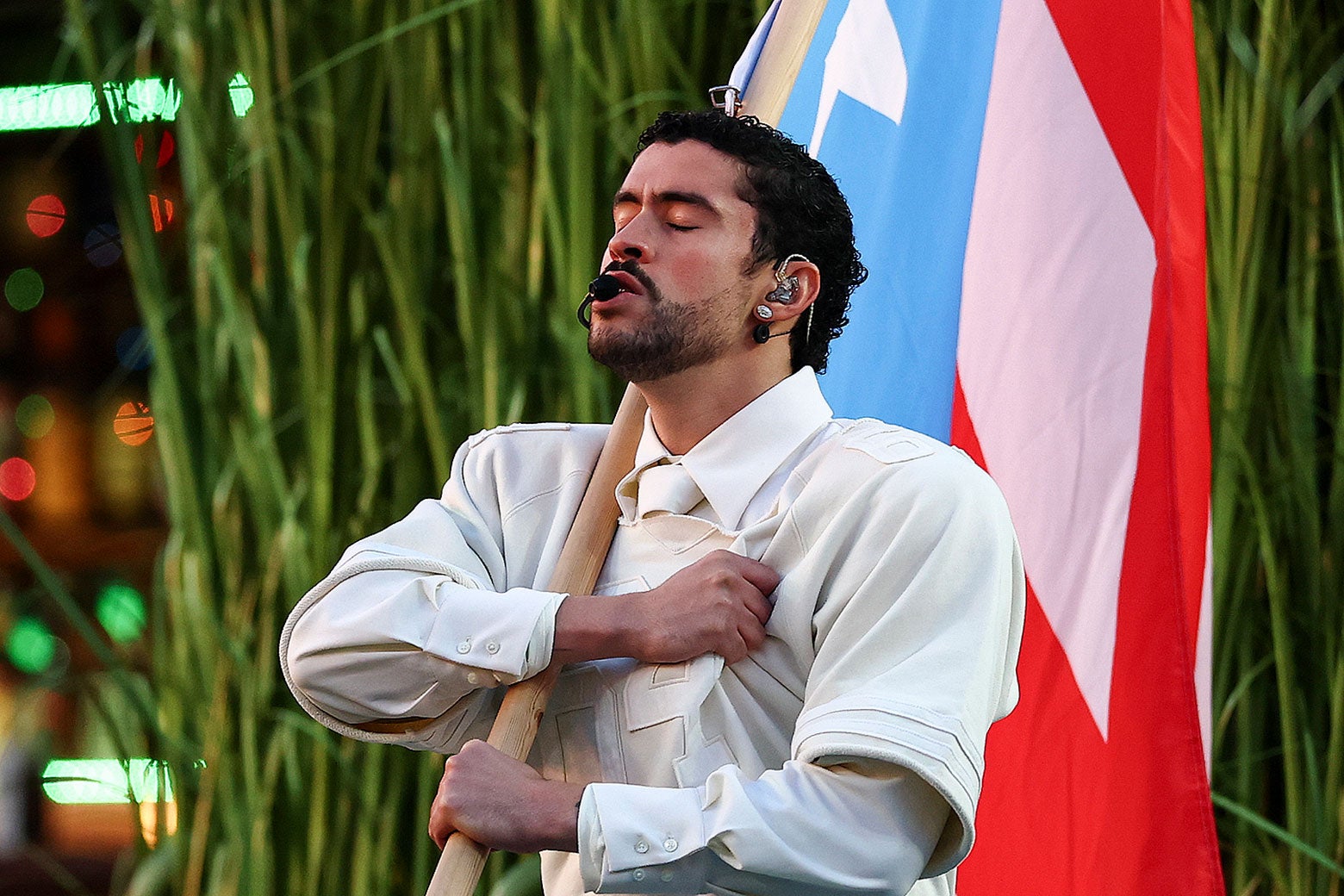
The performance was a celebration—a staunch embracing of joy. In a more heartwarming moment, Bad Bunny paused to highlight a young boy watching his Grammy win on an older-model television with his parents. In the present, Bad Bunny handed the boy a Grammy and told him, “Always believe in yourself,” suggesting that this boy was meant to represent a younger version of the artist. (Some fans suggested that this moment could be a reference to Liam Conejo Ramos, the 5-year-old boy from Minneapolis who was taken by ICE and separated from his family, a theory that was debunked following the performance.) But there were plenty of other references to the politics of everyday life, including Bad Bunny’s choice to perform “El Apagón.” The song (meaning “the blackout”) is a protest tune about displacement and other inequities facing Puerto Ricans, named after the rolling blackouts the island has faced in the years since Hurricane Maria in 2017. Bad Bunny performed it while climbing a powerline pole, with a Puerto Rican flag in hand, as dancers were on top of other powerline poles. This is unsurprising for the artist, considering the album itself is about celebrating the beauty of Puerto Rico while also being heartbroken by the political reality of gentrification and the effects of the tourism industry that the island’s inhabitants face. Bad Bunny has always been good at effective political messaging because he’s not usually striving to be overtly political, but he is aware that he lives an inherently political existence—one in which nostalgia surfaces not only as an effect of time, but because of what gentrification and inequality take from you.
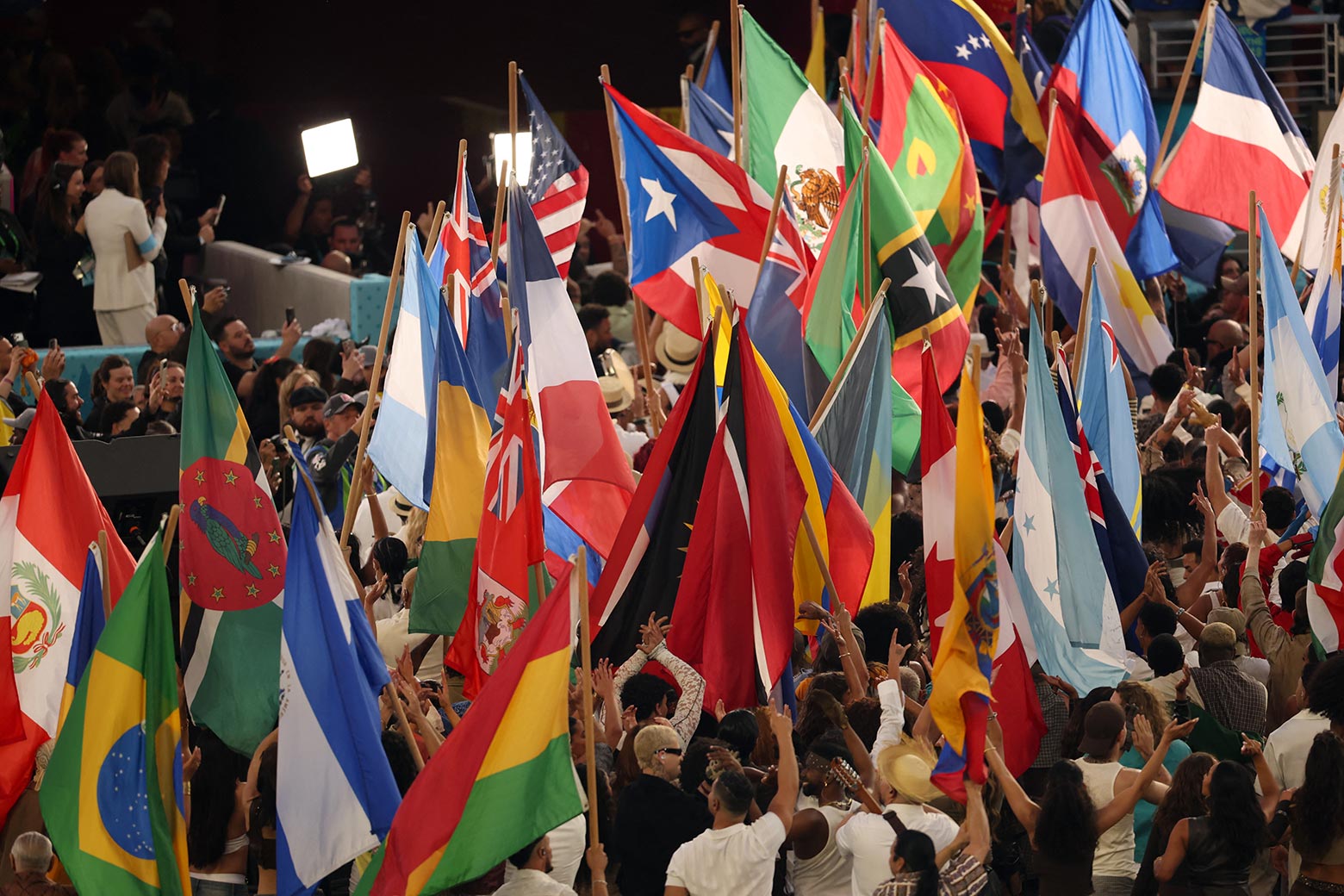
Bad Bunny finished his performance with the same thesis that he uttered on the Grammys stage: America is for everyone. With a billboard behind him that read, “The only thing more powerful than hate is love”—a quote from his Grammys speech—the artist performed DtMF’s eponymous title track as his final song. As female dancers in white tops and skirts—perhaps a reference to Santería, the traditional Afro-Cuban religion?—and male drummers in white shirts and tan slacks created a wall of percussion behind him, Bad Bunny started a pointed march while holding a football. “God Bless America,” he declared, before listing, with pride, countries in the Americas, including Uruguay, Costa Rica, and more. (As a Jamaican American, I was delighted to hear him yell “Jamaica” in Spanish.) Flagbearers representing those countries ran behind him, filling the screen with a colorful illustration of inclusion and harmony. Finally, he ended his list with America and Canada, giving a loving shoutout to Puerto Rico before holding the football out to the camera, showing that it read: “Together, we are America.” In many homes in America—certainly mine—tears were shed.
Bad Bunny’s message of unity doesn’t override the horrors that brought it into existence. It sits alongside it, the same way that the joy in Levi’s Stadium abutted the cause people were protesting outside of it, as anti-ICE activists with the coalition Contra-Ice passed out anti-ICE towels to attendees. Trump, for his part, posted on Truth Social that the show was “absolutely terrible” and a “slap in the face” to the country, highlighting the dancing as “disgusting” and claiming insultingly that “nobody understands a word this guy is saying.”
But the truth is: Most people, regardless of whether or not they speak Spanish or are Puerto Rican, will understand Bad Bunny’s performance. This was for immigrants in America, just as much as it was for international citizens in other countries, just as much as it was for activists and neighbors fighting for justice in Minneapolis. It was for every diaspora that has suffered at the hands of state-sanctioned violence. It was for all of these seemingly disparate groups—because they’re not disparate, but united by the shared idea of having a home and community worth protecting even if you migrate to another one. These groups understand that one of the most revolutionary things you can do, as history is wiped away before our eyes, is to create a record of history, one of piragua carts and coconut sellers and human connection on the dance floor.
I, like many others, understood this show because I understand joy. I understand that finding joy in where you come from, and clinging to it enough to re-create it painstakingly and lovingly on the largest stage possible—all while the source of that joy is openly and actively threatened—is not easy. But what matters is that you dare to do it. Regardless of whether you speak Spanish, it was immediately, universally clear that Bad Bunny left that stage just as brave, jubilant, and celebratory as he entered it.