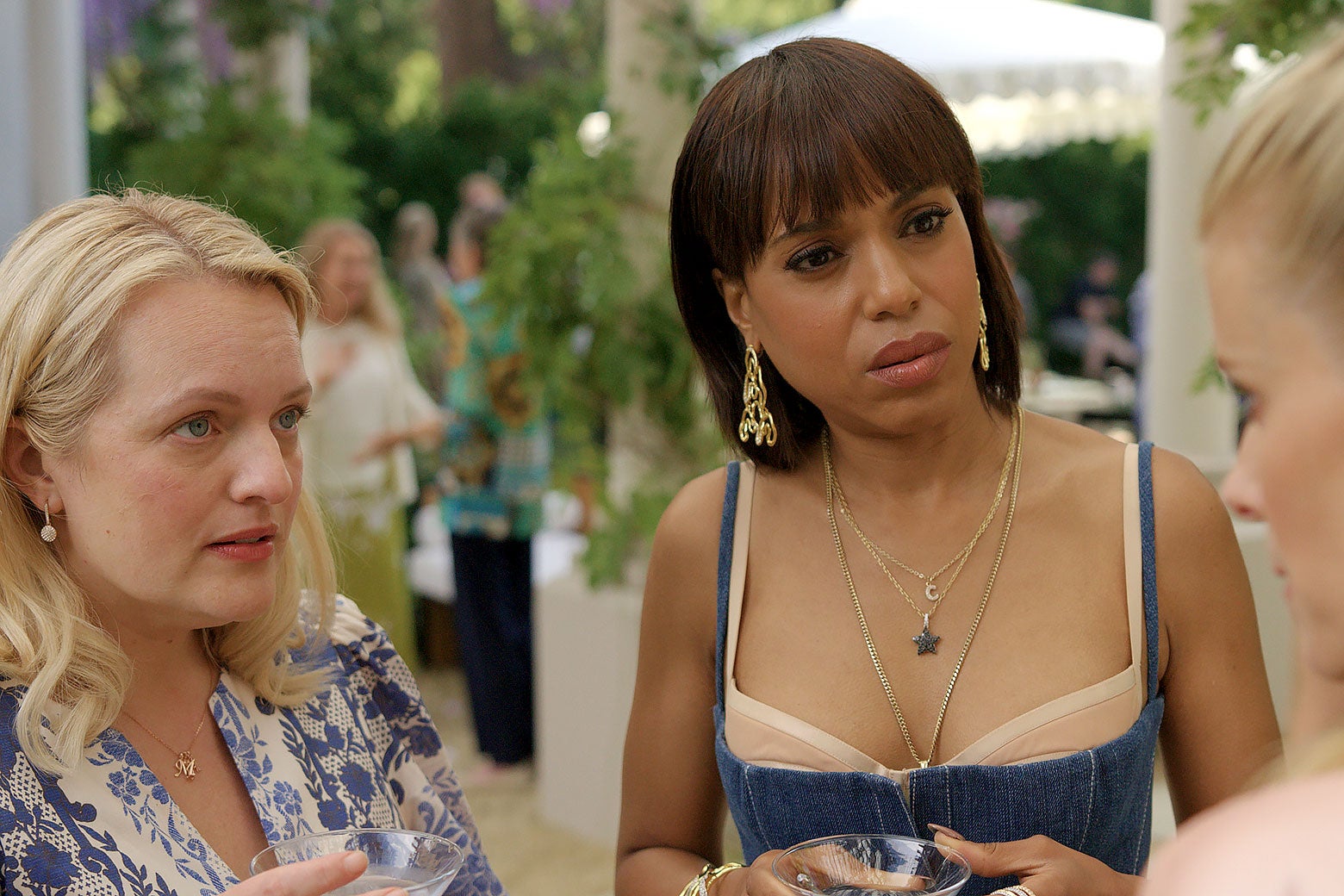
Apple TV’s new thriller Imperfect Women is the latest adaptation to aim for the audience that turned out early this year for The Housemaid: people with an appetite for entertainment that picks apart the domestic lives of the 1 percent, finding something stinky inside the pretty shell of catered parties, volunteer “jobs,” and perfectly beribboned gift bags. This limited series, which is being released on a two-episode-per-week schedule, is based on a book by Araminta Hall and created by Annie Weisman, who also made the Rose Byrne show Physical for the streamer. Imperfect Women’s bluntly descriptive title, along with the credit sequence showing pottery being mended using the Japanese technique of kintsugi, promises exactly what you’re going to see: a bunch of fortysomething female Angelenos who may seem like they’ve got it together, but have made a bunch of bad choices in their lives, and are about to make more. A trio of beloved actresses—Kerry Washington as Eleanor, Elisabeth Moss as Mary, and Kate Mara as Nancy—stand ready to reveal all these flaws to us as the first two characters investigate the first-episode murder of the third.
Eleanor carries the first few episodes. At first this character seems like a real boss, the head of a hunger relief organization staffed by idealistic zoomers and housed in a beautiful loft office decorated with blown-up A.I.-looking posters of undernourished foreign children. Washington playing a capable CEO feels comfortably familiar, and Scandal viewers may enjoy the romantic intrigue between Eleanor and Robert, Nancy’s generationally wealthy husband, played by Joel Kinnaman as an angular, tortured WASP, à la President Fitzgerald Grant. But Eleanor is the only one of the three women who has remained unmarried and child-free, and we soon see that in the world of Imperfect Women, there’s no way for this to be a neutral descriptor. By the end of her turn as narrator, capable Eleanor has shown herself to be just as chaotic, fixated, and emotional as her two best friends.
In the coming episodes, we’ll see the events of Nancy’s death from Nancy’s vantage, and then from Mary’s point of view. Mara’s Nancy is a ballet dancer with a pixie face who doubts that she’s actually escaped her abusive childhood, and the actress’s angular, middle-aged teenager look works well in this role. Moss plays a stay-at-home mom of three, married to the worst kind of male professor (Corey Stoll), a guy named Howard who is chronically underemployed because his so-called standards won’t allow him to take the kinds of jobs that academia offers or go afield to work outside of the ivory tower. (While the internal dynamics of this household are painfully realistic, the house where these two live is far too nice for an L.A. academic off the tenure track to afford.) It’s Moss—dressed in a way that widens her figure, like a real-life mom of three, and draped in fashion that the Brits would call “mumsy”—who emerges as the standout character, a dreamy woman trapped in a bad situation by her love for her children.
The idea that these three women are friends from college who see one another as their “people” (a Grey’s Anatomy reference one of them actually drops in a later episode) is a bit difficult to swallow. They seem misaligned—two of the three (Mary and Nancy) come from working-class backgrounds (a Northern California pot farm and a single mom in Bakersfield, respectively), while Eleanor is from a family so fancy that her brother (played by Leslie Odom Jr., who brings a welcome bit of humor to the table) sets private detectives to surveil her so that she can’t ruin the family’s reputation by messing around with Robert in public. Would these college friends still be daily presences in one another’s lives in their 40s? It’s hard to say why their youthful ties endured.
If you feel like being charitable to Imperfect Women, you could say that this asymmetry between the three women’s class situations is not improbable, but rather the very thing that drives the conflict between them. Nancy marries “up.” Both her friends are jealous (Mary, of her money; Eleanor, of her broad-shouldered Kennedy of a man), and they hide their jealousy for years, staying friends with Nancy because it’s to their advantage, but unable to properly support their actual friend because of their envy. There is something to this idea, but this kind of thriller—compellingly watchable as it may be—is a hard place to explore it well. Imperfect Women wants to offer you a look inside the Pasadena elite, surprise you with twist reveals, and disgust you with its characters’ hidden sins, not quietly observe how money and sex can ruin female friendships—not because the women aren’t perfect, but because the world isn’t.