Sign up for the Slatest to get the most insightful analysis, criticism, and advice out there, delivered to your inbox daily.
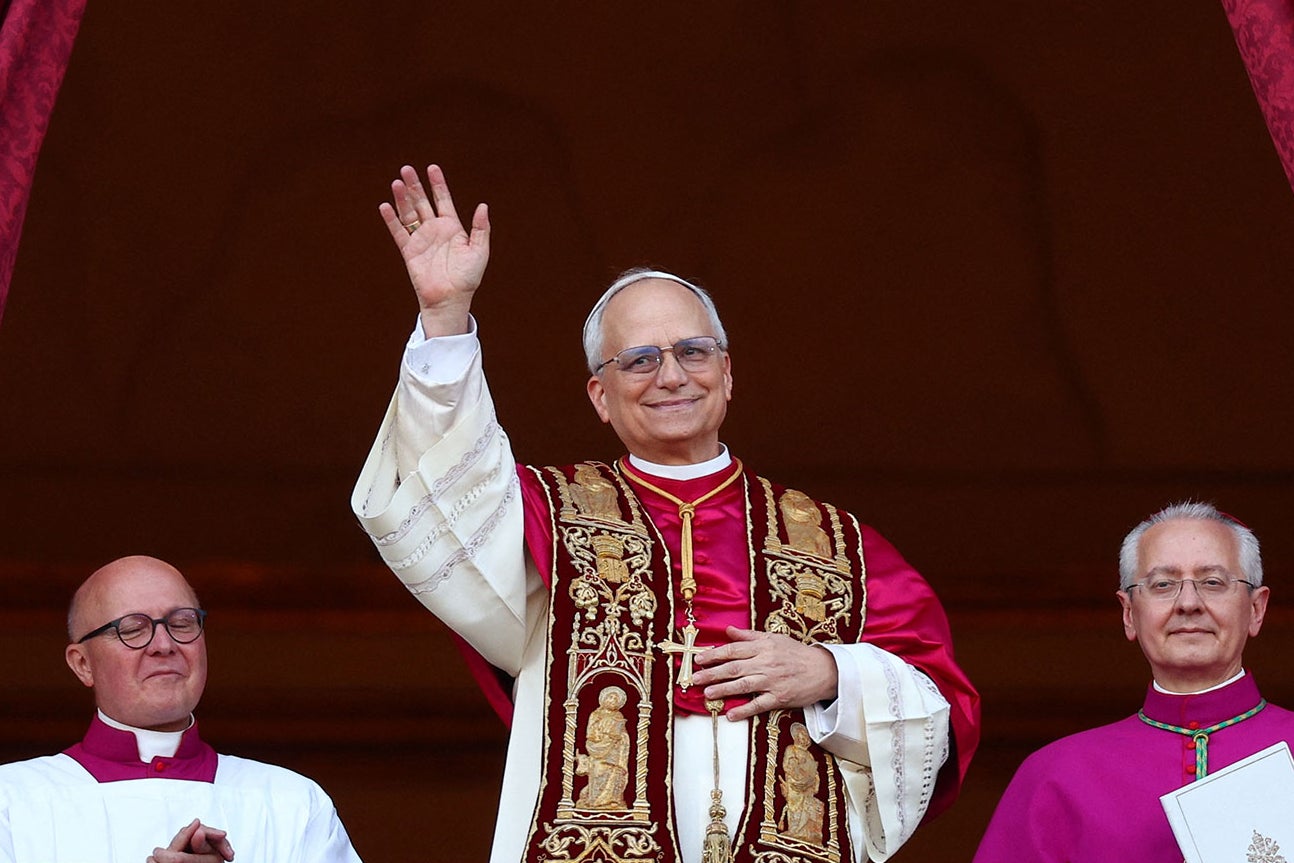
He emerged onto the balcony, smiling, to greet the tens of thousands of cheering, jubilant Catholics in St. Peter’s Square: the first American pope.
On Thursday afternoon—evening, in Rome—on a beautiful sunny day, Cardinal Robert Prevost from Chicago was elected the new leader of the Roman Catholic Church. He announced his new papal name: Pope Leo XIV.
Prevost, a 69-year-old from the Augustinian religious order, had been considered a moderate candidate with solid practical skills in dealing with Vatican politics but similar priorities to Pope Francis on the matters of immigrants and poor people. He has held somewhat more traditional attitudes on matters of women and LGBTQ+ rights and is expected to be more permissive toward the traditionalist faction in the church. On social media, some compared Prevost to the Stanley Tucci character Cardinal Bellini, from the popular 2024 movie Conclave, a film that has haunted these proceedings online, but that’s not quite right—Bellini is brash, while Prevost has been described as being more cautious and pragmatic than Francis. More than anything, this election seems to be one of continuity, rather than a push further left or a swing to the right. In his opening address, the new pope spoke of the need for a church that “builds bridges” and will “receive everyone.” It was a clear signal that he intends to maintain the approach that Francis brought to the papacy.
Prevost had been considered one of the leading candidates in the days leading up to the conclave, in large part because of his position as the head of the Vatican office that nominates candidates for bishops, making him something of a power broker in the church. But many Vatican watchers dismissed the possibility because they assumed that the cardinals would never select an American pope. It has been commonly believed that a pope from such a major superpower would make the rest of the church anxious.
Prevost spent much of his career in Peru, and as a result he had developed support from Latin American cardinals in the conclave. Latin America has a different approach to church matters, often described as “pastoral,” with a more pronounced history of social justice for the poor. He followed his Italian address from the balcony with one in Spanish—but not English.
It remains to be seen what it will mean to have an American pope. (Prevost holds dual citizenship with Peru.) We can assume he won’t be deferential to the more conservative U.S. church leadership, which has been friendly to the Republican Party. On social media, he has criticized J.D. Vance’s views on the Catholic teachings on caring for others, as well as Donald Trump’s immigration policies, and last month he reposted harsh criticism of Trump’s laughter in the Oval Office, regarding the imprisonment of Kilmar Abrego Garcia.
Despite these political statements from Prevost, the election was probably not meant to stick it to Trump, Vance, or MAGA. The decision had taken just two days, with four rounds of votes: a sign of unity from the 133 cardinal electors, who wanted to spread the message of brotherhood in the church, rather than ideological division. Everything about the process carried meaning. His papal garments, which were more ornate than Francis’ when he emerged, seemed to indicate a return to some of the more ritual-oriented traditions.
As Catholics waited for the new pope to emerge, Prevost prayed and dressed in the new garments in an antechamber that’s known as the “Room of Tears,” a name gesturing toward the heavy emotional weight of the realization of his responsibilities. Meanwhile, the Swiss Guard and the Vatican band proceeded through the square. After Prevost was announced, to cheers, some began to process the historic first. On live feeds from the square, some Americans chanted: “USA! USA!”
The conclave had begun Wednesday, a little more than two weeks after Francis’ death. The 133 cardinal electors were sequestered inside the Vatican compound; the Sistine Chapel, where the elections had taken place, was swept for bugs, and signal jammers were activated to lock down communications. The cardinals were allowed no contact with the outside world.
We can’t know exactly what happened behind the scenes to come to the decision. Later, some of the cardinals may share insights into the decisionmaking with Catholic journalists. But we will never know the exact politics; some cardinals may have struck deals or offered other reassurances to competing factions and players. Many of the factors are significantly less ideological: These men consider personalities and charisma, geography, particular experiences with Vatican jobs, and even particularly compelling speeches. Some want statesmen; some want pastors. But the reality is that, whatever Prevost has done, we can’t know what kind of pope he’ll be. Few expected Francis to become the figure he became. It will take time for us to know what this choice will really mean.