Sign up for the Slatest to get the most insightful analysis, criticism, and advice out there, delivered to your inbox daily.
My father once said I’d know I was old when someone made the songs of my youth into lounge music. I didn’t expect it to happen at a New York Fashion Week party for a conservative women’s magazine, or that I’d spend the very next night watching one of my favorite musical artists from high school simulate sex acts with a microphone at a Pornhub-sponsored bash in a packed East Village bar. I’m dizzy from the whiplash, and more than a little hungover. Culture wars are a lot more fun when they’re fought with open bars.
There’s no button to summon the elevator for Boom, the private event space atop the Standard High Line Hotel where Evie Magazine threw a party to celebrate their spring release, “The Sex Issue.” A silent attendant sends me skyward and into a world of plunging necklines, skirts slit to the waist, satin draped in sizes 0–2. The night’s entertainment is a singer with long blond hair, a beautiful face, and collarbones like cut glass; she sways in a cheetah-print gown as she covers Franz Ferdinand’s “Take Me Out” and Sublime’s “Doin’ Time” in a voice like butter.
This might feel like a regular party, but Evie isn’t like the other magazines. “While women’s magazines have pushed agendas driven by one-sided politics, cultural anti-values, and ad-driven profits, Evie takes an entirely different approach,” the magazine’s “About” page declares. Evie’s founders, married couple Brittany and Gabriel Hugoboom, reject “mainstream culture that encourages women to engage in destructive behavior in the name of self-love and empowerment.” They’re vaccine-skeptical, rabidly transphobic, and against hormonal birth control. Lots of sunlit photos of women in cotton dresses. Breezy tradwife chic.
You could easily pick up Evie and not realize what you’re holding until you’re several articles in; most of the articles are exactly what you’d expect from an elevated version of Cosmo. But for every “The Only Skincare Ingredients You Actually Need” there’s an “I Don’t Want to Be Independent Anymore”; for every “How to Dress Like Olivia Dean on a Budget” there’s a “Why I’m Building a Village Instead of a Career.” These articles usually drop a sentence about women’s freedom to choose their own path, but make it clear that feminism and pop culture have brainwashed women into wanting things other than the soft-focused, airbrushed things Evie wants them to want.
Some publications call Evie Magazine alt-right: a label that, while not unfounded, is also incomplete. Many of the problems they address are very real and often dismissed. Our dual-income society makes stay-at-home motherhood both difficult and stigmatized. Commitment-phobic hookup culture makes marriage proposals harder to come by. And complaints about hormonal birth control aren’t some pronatalist stealth campaign; I quit the stuff years before it became conservative-coded to do so. Evie doesn’t have great solutions to these problems, but the problems themselves are real.
The “Sex Issue” cover sits on an easel near the lounge singer. It features a model against a red backdrop with legs half-crossed, a sheer veil in her long brown hair and a white bustier that accentuates lush cleavage. White satin heels, white lace stockings, white diamond ring on her finger; airbrushed, Juvedermed, and staring into the middle distance. She seems neither happy nor sad, anticipatory nor disgusted.
That bridal lingerie is key; “The Sex Issue” is intended for wives only. “Many young women, especially from traditional or religious families, have come into womanhood without learning anything about sex,” Hugoboom explained in a press release. “They grew up with negative associations to intimacy, but were expected to become uninhibited the moment they said, ‘I do.’ ” “The Sex Issue” will include explicit (yet tasteful) articles that explain things like “The Core Sex Positions” and “The Complete Orgasm Roadmap.” It’s “the most Evie thing we’ve ever done,” she said, which seems accurate; the magazine specializes in conservative-coded solutions to conservative-caused problems, as when they recently blamed the manosphere’s disgust at Rihanna’s postbaby body on feminism’s “culture of anti-motherhood” and the orgasm gap on husbands being emasculated by career-pursuing wives. A sex-positive approach to purity culture? Better than the alternative, I guess. Kind of.
The party is exquisite. The open bar, beyond generous, offered everything from signature cocktails to top-shelf scotch and a pyramid of Champagne glasses filled with Moët & Chandon. Everything (and everyone) is beautiful and expensive and highly ornamental. The men—mostly young, besuited, and painfully ordinary-looking—are catastrophically outnumbered by women with long loosely-waved hair in expensive eveningwear that breaks no fashion ground. The only exception to these rules—and the center of attention wherever they go—is a couple who might have traveled here from Wonderland. She wears a pink velour pantsuit and tiny top hat wreathed in flowers; he wears a vest, bowtie, and a Stetson he bought at a Renaissance Faire five minutes from where I grew up. He’s a college friend of Brittany’s husband, she’s a wardrobe stylist who curates themed events and Airbnb rentals, and they both flew out from Miami to see New York and attend the festivities. We talk about our hometowns, board games, and Bushwick’s House of Yes venue, and do not mention politics at all. People keep asking to take pictures with the couple, and I understand completely: They’re a breath of fresh air, a shot of whimsy in a room full of people desperately trying to look like they belong.
Toward the end of the evening, I meet Hugoboom entirely by accident when I compliment her sequined leopard-print gown. She’s tiny and gorgeous and taking a photo with a young blond woman in a draped white dress who looks both ecstatic and overwhelmed; exactly the kind of reader Hugoboom wants for her magazine, the founder tells me. Maybe that reader is who this party is for as well. Maybe all Fashion Week parties are like this: boring events you attend in order to say you went, whether to your friends or on the pages of Vanity Fair, or the Cut, or Slate. I toss back a final drink, collect my coat, and return to the pedestrian world of overcoats and hat hair.
The next day, hungover and full of ennui, I received an invitation to a very different kind of party. “We invite you to actually feel something with Thrust, a new magazine coming summer 2026,” it read. “Open bar, open minds.” The pre-launch party will feature a performance by the magazine’s first cover girl: Peaches, the musical artist behind “Fuck The Pain Away,” “The Boys Want to Be Her,” and other songs I listened to obsessively in my early, closeted 20s.
Say less.
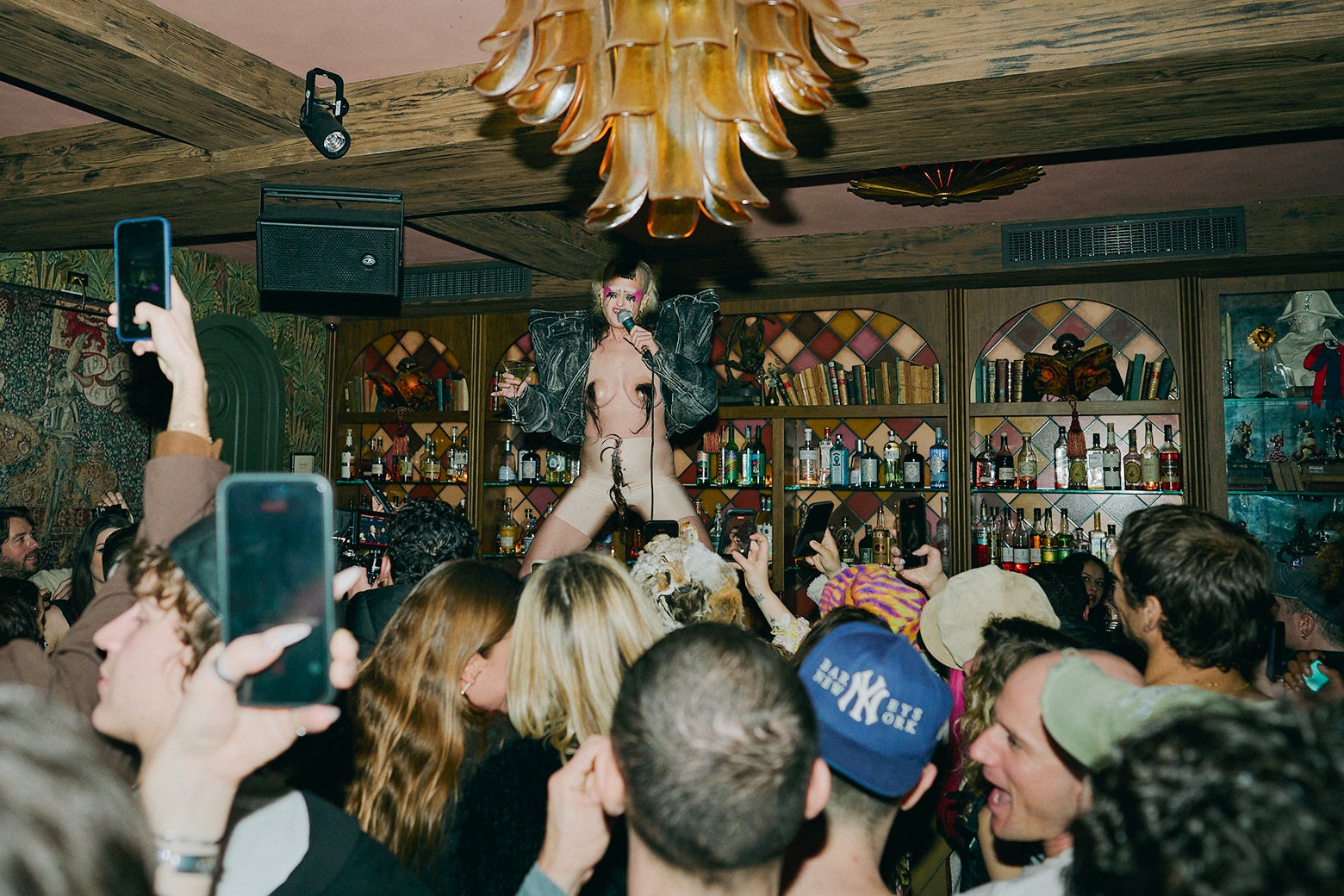
This is how I found myself, several hours later, in a fire-code-defying crush of fake fur coats and platform heels, watching Peaches take the stage—by which I mean the bartop—in nothing but an upside-down black puffer coat, pasties, and an aggressively unattractive pair of white nylons Frankenstein-stitched together with black yarn at the crotch. She’s sporting jet-black bangs and a blond mohawk pulled into a ponytail, pink eyeshadow, lashes the size of butterfly wings. Peaches belts out her 2025 single “Fuck Your Face,” then pauses to swing the microphone slowly from shoulder level to crotch, to shoulder, to crotch, for what feels like a very long time, before jumping into the crowd and finishing off her set borne aloft by dozens of hands directly beneath the disco ball.
After her set, the crush lets up a bit and people beeline for the open bar and/or the dance floor. A woman wearing a deer head muzzled with a spiked leather strap gyrates to Lords of Acid; a muscular twink in silver pants and a Sex Pistols crop top tears the floor to shreds. The men dancing to my right start to make out. A queer bacchanal.
Thrust is the brainchild of Justin Moran, a former editor at Paper Magazine who declined to comment for this article, and Pornhub, a website you may have heard of. It hopes to be a magazine by sex workers, for sex workers, and also for the world that misunderstands them. “The goal specifically is to make these stories and these topics—I don’t want to say palatable, but I think relatable,” Alexzandra Kekesi, Pornhub’s vice president of brand and community, told me. “The sex worker’s struggle is a women’s struggle, and it’s a labor struggle, and it’s a racial struggle. It’s about disability rights. There’s so many intersections there.”
Kekesi also hopes the magazine can introduce some nuance into public policy debates about laws that attempt to restrict the industry—something Pornhub obviously has a vested interest in, but which may have disturbing implications for the public and performers as well. “We don’t want children on our platform,” Kekesi said. But “the laws are not protecting kids. They are just driving users to other, much more dangerous and unregulated platforms.” Preliminary research backs her up on this.
I have no idea whether Thrust will be a success or not—magazines launch and then flop every day. But cultural innovation traditionally comes from crowds a lot like this one: the freaks, the queers, the marginalized. People on the fringes who try things out to see what sticks.
The right has lusted after control over American culture ever since Andrew Breitbart declared it upstream from politics. But their would-be vanguard has a problem: Conservative longing for some real or imagined past means they can only look behind them. The fashion at Evie’s party was gorgeous, but it was also mostly safe. As Wired pointed out, Boom was an “it” venue 20 years ago but feels steady and staid today. The magazine’s articles have a similar problem. Despite their avowed hatred of feminism, they borrow concepts from it constantly, from their article about how to say no after you previously said yes to the entire concept of an orgasm gap. The magazine is anti-porn, anti-kink, even anti-vibrator, but articles like “How to Give a Lap Dance: A Step By Step Guide for Wives” are ripped straight from the adult industry. Their only novel contributions involve things not to do: don’t have kinky sex, don’t go to therapy, don’t sleep around before marriage. Of course their party featured an even loungier cover of a Lana Del Rey’s lounge cover of a song by ska-punk junkies.
Back in the East Village, the party is winding down. A girl sits on the bar and eats one of the peaches strewn across the room with a black “Thrust” flag thrust into it. People exchange numbers and Instagram handles as they collect their coats. A woman in a red latex dress with the seven deadly sins written in black across the front poses for a picture on her way out the door and into our cold winter world.
The culture war isn’t about hookup culture vs. waiting until marriage, or career vs. motherhood, or porn star vs. prude. It’s rigid, prescribed roles vs. the right to make a choice. People who let their freak flag fly are unfurling a banner for freedom for everyone, from the mainstream to the fringe, and Peaches is belting out a raucous national anthem. God bless America.