Sign up for the Slatest to get the most insightful analysis, criticism, and advice out there, delivered to your inbox daily.
At most pizza places, when it comes to the crust, the customer will be presented with a range of options that include thin, deep-dish, and gluten-free. But you never see “bagel,” for some reason, even as many of us grew up devouring pizza in this tiny, round form. Ordering the other night, I had to restrain myself from asking the pizza guy, “Could I get that with extra cheese and served on 20 mini-bagels in a cardboard tray? Thanks!”
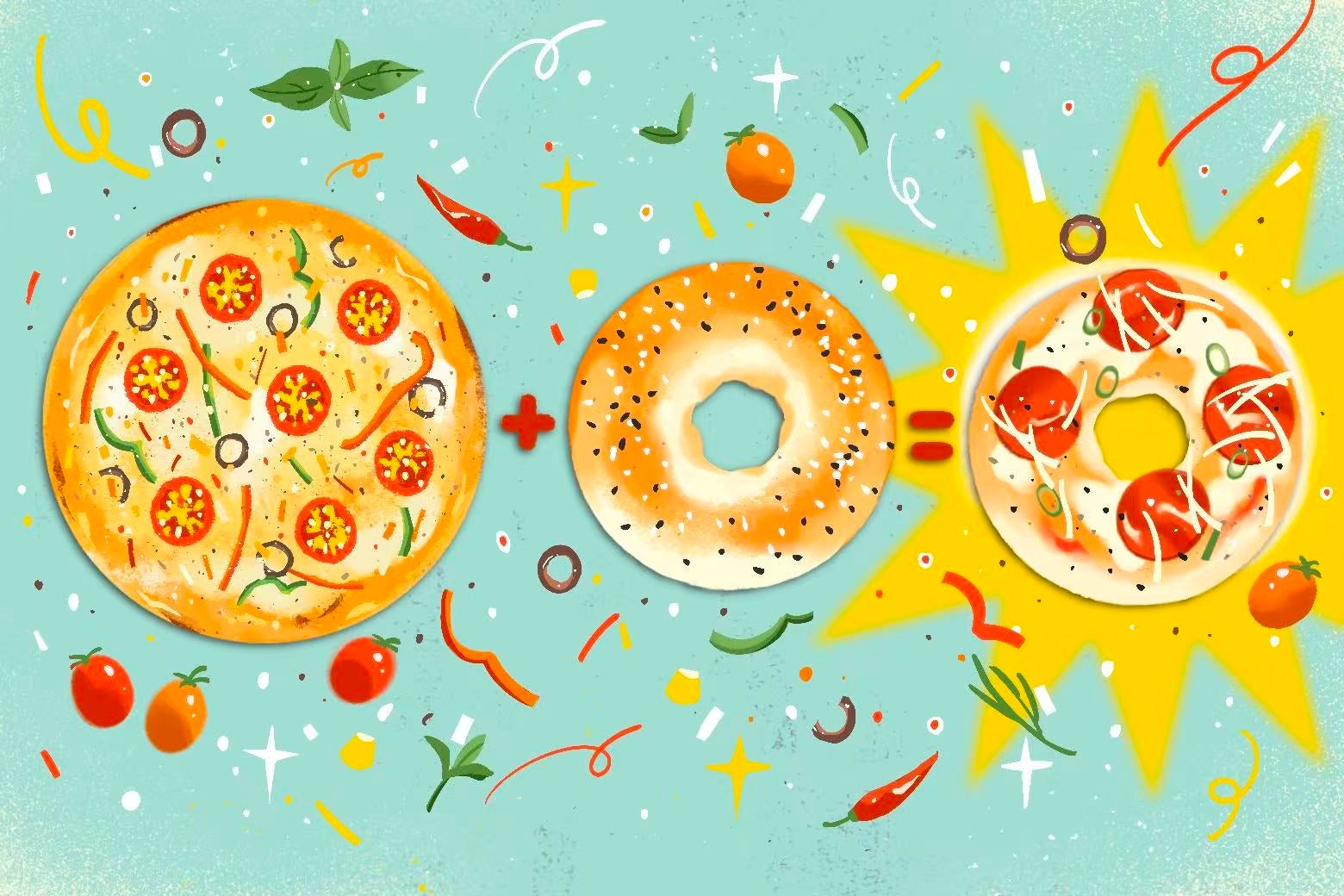
It’s a shame he would have hung up on me, because the pizza bagel is one of the great original fusion foods—or a total dilution of two unique cultures, depending on how you look at it. But none of that think-piece crap remotely entered the mind of a generation of kids and stoned college students as they rushed home after school, slung a tray of Bagel Bites into the microwave (or oven, if they were an aristocrat), and watched the little mozzarella cubes melt until they overflowed off the bagel into crispy volcanic cheese bits below. All except the ones in the center, of course, which remained a tad undercooked.
If the local bakery that offered pizza bagels was closed, a few of the more patient and diligent kids found some leftover jarred marinara and rubbery shredded cheese, heaped it atop a bagel (or even, in times of desperation, a stale English muffin), and made their own artisanal version. They all probably work for NASA now. But no matter how it was made, it was the quintessential food of leisure and convenience, a hybrid that long preceded other culinary crossovers, like the cronut and KFC’s Chizza.
In an era when it seems as if disparate cultural snacks are being jammed together in a parade of misfit creations—see pizzadillas, ramen burgers, and croissant waffles—it’s important to remember the OG mass-market fusion nosh. What is now a gimmick to gin up the next viral eat was once a leap of faith between two established foods willing to put egos aside and work together. Well, I mean, pizza bagels were a gimmick too, but they were one of the first, and they paved the way for the current glut of experimentation. It’s quite a legacy.
But where did the pizza bagel come from? What now may seem like a friendly unification between Jewish and Italian American culture actually began as a feud between the East and West coasts.
Credit for invention depends whom you ask. Ask Katz Bagel Bakery in Chelsea, Massachusetts, and you’ll get a pretty convincing case. “Nobody makes a pizza bagel like we do,” says Richard Katz (pronounced “Cates”), son of Harry Katz, who opened the still-running bakery in 1938. His father’s concoction from around 1970 doesn’t quite resemble the pizza bagels many of us grew up with, but there’s a reason for that. Whereas most take an already-baked bagel and slather a dollop of sauce and cheese on it, Katz used holeless disc-shaped bagel dough as the base so the bagel bakes only once, ultimately retaining the moisture of one of the shop’s regular fresh bagels. It’s a method his son Richard continues to use today.
“It takes a roll machine, it takes a press, and it takes a kettle,” says Katz. As he sees it, doing it the other reheated way produces a drier bagel base. “You take a bagel and bake it for 20 minutes, you take it out of the oven, cut it in half, and put sauce and cheese on it and put it back in the oven,” he says. “What do you think that does to the pizza bagel? It makes it like a fucking rock.”
For a time, the bakery even sold frozen versions at local grocery stores, like BJ’s. Katz insists his father’s single-bake method is the authentic version of the snack. “That’s how pizza bagels got invented … and some assholes in California said they invented it.”
That shot is likely a reference to Bruce Treitman, a current financial adviser and former employee of Western Bagel in California, who’s been a regular thorn in the side of Katz by claiming that he’s the one who actually invented pizza bagels. It’s why he half-jokingly refers to Katz’s version as an “English-muffin pizza.”
Treitman’s purported iteration was more traditional in nature, if a pizza bagel can be called traditional. As high schoolers in the early ’70s, he and his friend Mark Silver were working at Western Bagel plenty of hours, and eating plenty of bagels. “We tried to spice it up a little bit,” he says. “There was a supermarket right next door, so we got some pizza sauce and some mozzarella cheese, put it on the cooked bagels, and heated it up. Other workers liked them, and so we started selling them at 55 cents each.”
Soon, other locations of Western Bagel began selling them as well, and the rest is pizza bagel history, at least according to Treitman. “It was my idea, executed by myself and Mark Silver. And that’s how it started.” While Treitman clearly enjoys trolling Katz, he does admit that it’s a good bakery; he just doesn’t consider its version to be the first. “I don’t think it’s a pizza bagel,” he says. “It looks like a pizza, which is fine. Pizza is great.” Some Western Bagel shops still sell pizza bagels today, but it isn’t called the Treitman or anything—though he says they give him credit (just not royalties, which he’s fine with).
Other claims tend to get lost in the coastal hubbub between the above two parties, and that coast stretches all the way down to Miami. Old Miami News stories unearthed by journalist Doug Mack suggest that in the early 1950s Miami baker Artie Adler created a version of the pizza bagel, sometimes called the “Bagelizza,” a name that clearly didn’t take off. And let’s not forget the Midwest, where rumors persist that Ohio baker Anthony DeMauro, of Amster’s Bagel Bakery, broke the pizza-bagel barrier in the late 1950s. Of course, it didn’t help that he waited until 1970 to copyright the name Amster Pizza Bagel, Inc.
Whoever did come up with it first, we do know that it wasn’t Bagel Bites. The company merely swooped in on a burgeoning trend and pushed it into the zeitgeist. Created by caterers Stanley Garczynski and Bob Mosher in the early ’80s, Bagel Bites were a quick hit, and the two sold the company a few years later to John Labatt Co., which later sold it to Heinz. In time, the little squishy pizzas reigned supreme as the definitive frozen after-school snack, hypnotizing a generation of kids with jingles like “Pizza in the morning, pizza in the evening, pizza at suppertime!”
All that said, applying forensics to the invention of a cultural-hybrid snack like the pizza bagel is something of a fool’s errand, because it wasn’t created in the classical sense of a singular invention. Rather, it’s an inevitable amalgamation of two cultures living in proximity to each other, a sign of a gradual integration into the mainstream.
“It would be interesting to make a comparison between the pizza bagel and corned beef, which was kind of a Jewish-Irish mashup, and something that was popular in both communities,” says Ted Merwin, the author of Pastrami on Rye, a history of Jewish delis. “The Irish were eating corned beef and cabbage, and the Jews were eating corned beef sandwiches. So there’s this example of different immigrant groups living cheek by jowl with one another and, as time goes on, participating in the same mass culture.”
To me, it seems totally natural for regional bakers on both coasts, and even between them, to have come up with their own spin on the pizza bagel, just as there are various claims on the invention of the bagel itself. And if that one hasn’t been settled yet, there’s no hope for this one. Moreover, pizza bagels are especially hard to trace because, while bagels are a fairly defined form, American pizza is more of a malleable concept.
For decades, industrious hungry people have been slapping pizza fixings onto any available base, including English muffins, French bread, matzo, flatbread, pita, naan, you name it. If frozen pizza in any form isn’t available, a desperate college kid will search his kitchen like the Terminator for any flat surface upon which to toss a little leftover marinara and mozzarella. It usually begins with lofty ideals like bagels and flatbread and ends with last-ditch pizza bases like saltine crackers and rice cakes. God, I need to get a job, he soon thinks.
So, as pizza and bagels were proliferating in the American mid-century consciousness, one can imagine multiple bakers getting the idea to create a chimera of the two. Think of it like early physicists across the world looking at bombs and the atom and realizing that both could be combined into something pretty big. Except in this horrible analogy, the expanding nuclear mushroom cloud is the American waistline.
In our time, we can see a similar process taking place, with chefs tossing taco fixings into any available dough (like wontons and bao buns), and burgers and sushi taking on fillings from multiple cultures. New frontiers are being conquered every week. It’s why we have sushi burritos, butter-chicken pizza, ramen burgers, and Korean tacos, among countless other dishes that initially cause me to say, “That’s stupid! I’m not eating it,” before soon admitting that it’s delicious. And without even looking, I know that there are already multiple arguments about who came up with them first.
It’s our endless desire for snack novelty that fuels these creations, and in the margins between disparate popular things that seemingly have nothing to do with each other, there’s always someone trying to strike gold and successfully unite them. It’s why we have the clock radio, pickleball, key chains with bottle openers, and Branson, Missouri. Food-wise, the pizza bagel deserves early credit for showing us all what’s possible. Like any good fusion snack, it’s tasty, annoying to the traditional cultures it bastardized, and probably not as good as having the originals separately. But it’s after work now, and I’m tired. I gotta eat.