Sign up for the Slatest to get the most insightful analysis, criticism, and advice out there, delivered to your inbox daily.
Knockoffs of more popular brand-named snacks are so rampant in the grocery industry that many of us had entire childhoods based on them. Memories abound of parents returning home from the grocery store with the cheaper, off-color doppelganger of the cooler snack, much to their kid’s disappointment. This meant Stauffer’s Whales instead of Pepperidge Farm Goldfish, Tootie Fruities instead of Froot Loops, and chips that were so generic that their brand name was actually “Potato Chips.”
When such cheated children complained to their parents about cupboards filled with food that looked and tasted a little off, they usually smiled back wistfully, as if to say, “Hey, we didn’t get to marry the people we actually wanted, so you don’t get brand-name treats.” Just me?
Whatever you called them—knockoffs, dupes, look-alikes, imitations, that shit in the piss-yellow box—you knew these products on sight. They all live in an uncanny valley of snacks where it seems like aliens have replaced everything familiar with some hastily-put-together clones. But it’s not just kids who complain about them; it’s the companies being copied as well. And then, sometimes, they file lawsuits.
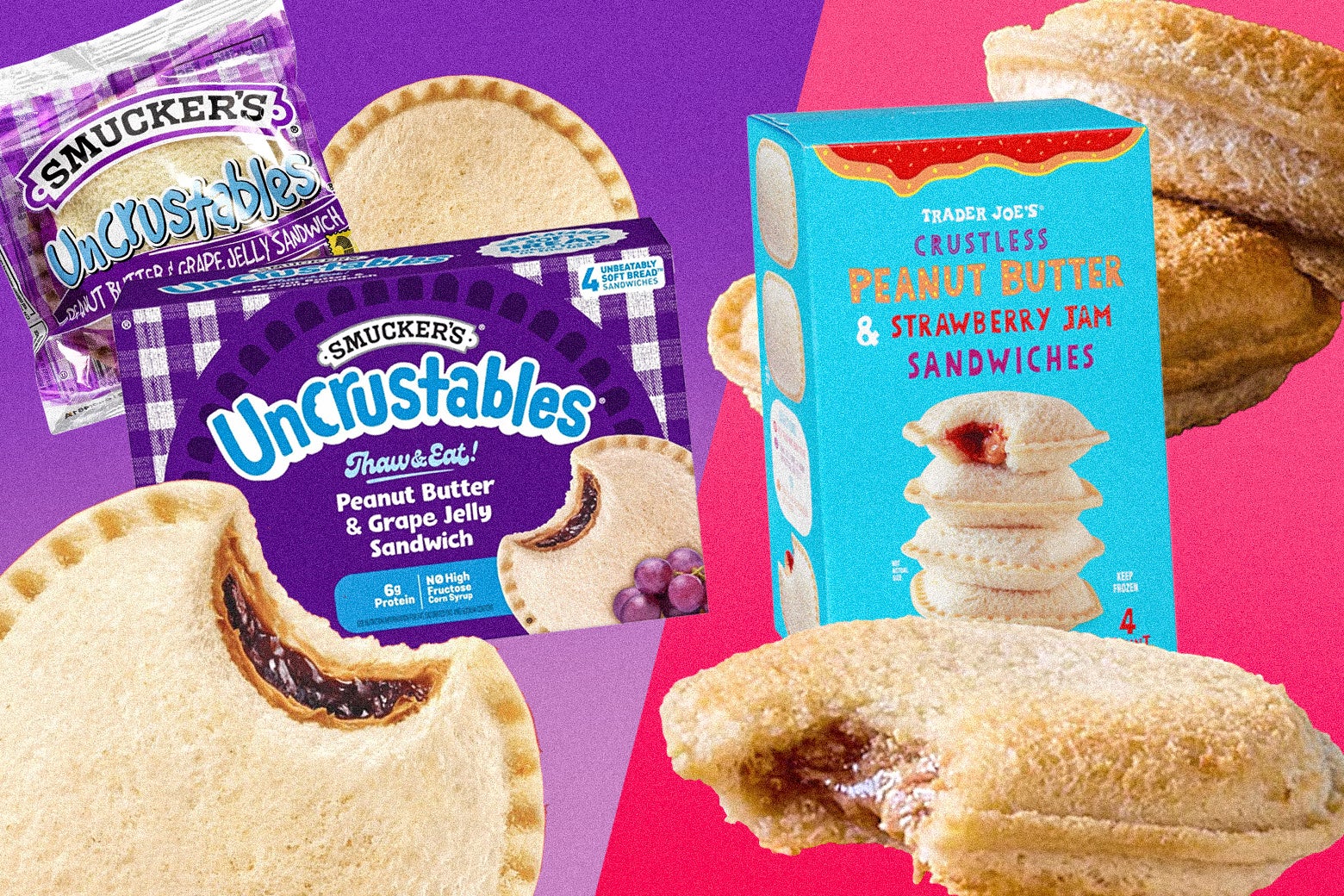
Out there in the wilds of the grocery store aisles, brands are lawyering up and filling their baskets with paperwork. Recently, J.M. Smucker sued Trader Joe’s over claims that the brand was hawking a brazen copycat of Smucker’s iconic PB&J pouches, Uncrustables, with similarities you couldn’t tell apart in a police lineup, like crimped edges and a specific shade of blue on the packaging. A few years ago, the Georgia-based Garnish & Gather meal service sued Target for their not at all similarly named Good & Gather product line. And perhaps most egregiously, last year Oreo-owner Mondelez sued Aldi, alleging the chain is mimicking many of their cracker and cookie products.
Here one can imagine an executive at Aldi scoffing at the dripping irony of the suit: “The Oreo people who ripped off Hydrox cookies are suing us for copying them? I hate everything.”
That’s certainly what makes all the litigation a bit confusing. Dupes are to the grocery industry what speeding is to driving. Every company’s been doing it for decades. Brands like Aldi, Costco’s “Kirkland Signature,” Walmart’s “Great Value,” Target’s “Good & Gather,” and Kroger’s “Private Selection” seem to go around the food industry like Agent Smith in The Matrix and swallow up original snacks. Trader Joe’s has even been accused of approaching smaller food brands under the guise of a possible deal and asking for changes to recipes, only to end communications and put out their own version. (In response to such allegations, TJ’s has commented that they’re “unable to work with every company we contact and realize our decisions to not pursue certain products can be disappointing.”)
But is all this legal action as frivolous as it seems? Dupes are ascendant, and grocery history shows that if one plays one’s cards right, they can convince the world that the original never existed.
“It’s a fairly incestuous business,” says brand anthropologist and History Channel storyteller Jason Liebig. “Back in 2020, the Fararra company launched Nerds Gummy Clusters and blew open the gummy category. That took the Nerds brand in the subsequent five years from $50 million a year to nearly a billion dollars. So basically everyone else is like, ‘OK, what crunchy thing can I sprinkle on my gummy?’
“It’s everywhere,” Liebig continued. “You do have inspiration, but then you have blatant copying. There was a huge snack brand called Tom’s, and boy they were prolific. Any product that was out there—Doritos, they had their version of Doritos. If there were Twizzlers, they had their version of Twizzlers. It was unmistakable when you would see what the Tom’s product was meant to be copying.”
Once in a while, dupe brands do get caught, make a minute change to the package to satisfy the company they were “inspired by,“ and then go on stealing ideas after the lawyers drive away. The brazenness is almost built into the business models and has been happening for as long as companies have been producing tasty snacks. For their part, Oreo is perhaps the most successful dupe in snack history, because they convinced the world that Hydrox—who invented the creme-filled chocolate sandwich cookie in 1908—is the imitator, and that Oreo was somehow the original. Oreos didn’t hit the market until four years later but accompanied their version with a superior marketing campaign and a name that, let’s be honest, is clearly better. Hydrox sounds like a word a rocket engineer would use to explain why a shuttle exploded.
It all unfortunately shows what stays crispy in the milk longest: lies. But at least Oreo gave Hydrox a bit of a head start before inhaling their soul. The same could not be said for Kellogg’s. Many know the story that provided the loose inspiration for Jerry Seinfeld’s movie Unfrosted. For decades, Kellogg’s and Post waged a cold cereal war long before the actual Cold War. But in the early 1960s, Post took it up a notch by coming out with Country Squares, the seemingly first fruity toaster pastry. They had the idea but not the vision. While Country Squares got a limited release, Kellogg’s took the opportunity to get their food chemists to work around the clock in developing their own version, releasing Pop-Tarts just six months later, and sweeping Post out of the market before they could get their foil wrapping off.
In a way, Oreos and Pop-Tarts are everything a scrappy young dupe could hope for: All those off-color clone brands yearn to be seen as a real boy. And that may be the reason why food-brand lawsuits feel a bit more prevalent these days. In the past, generic brands were mostly the matter-of-fact cheaper product that people bought to save a little money, which competing brands somewhat accepted as part of doing business. But generic brands have evolved, don’t taste as bad, and are occasionally seen as desirable or even exclusive. Countless grocery stores now have their own private-label brand, and Trader Joe’s, a forerunner in the practice, is essentially just a cool generic brand expanded into a whole store. So now there’s an entire culture around people seeking out dupe products, as though they’re hacking the grocery system.
“There’s this acceptance of dupe culture,” says trademark attorney Josh Gerben. “It used to be: ‘I don’t want people to know I got this knockoff product, it shows that I don’t have money for the real thing.’ But all of a sudden it’s cool to find knockoff products, because maybe the brands are overcharging.”
Gaze across the frantic hype landscape that is TikTok and Instagram, and you’ll find countless food influencers hunting for dupes like truffle pigs and praising them as superior to the original, driving thousands of fans to seek them out at a specific store and emptying grocery shelves as a result. It’s not just about saving a little money anymore; it’s about feeling as if you got one over on the inflation-ridden grocery industry, all while participating in a social media food trend so you can comment, “Yummy!” And it’s a sales trend that’s caused brands like Mondelez and Smucker’s to be like: “OK, enough of this shit.”
For dupe brands, there’s a fine line between trying to resemble the more popular brand and deceiving customers into thinking it’s the same product, which is what most of these lawsuits center on. “These companies started to what I’d call ‘fly closer to the sun,’ and the packaging got more aggressively similar to the brand,” says Gerben. “Trademark law exists to protect the consumer, not to protect the company that makes the brand. The idea is: ‘We don’t want a consumer going into a store, buying a generic product thinking it’s related to the brand, and not knowing the source of the product they’re buying.’
“If a consumer would be confused—they’re buying this knockoff thinking they’re buying a branded product—then you have trademark infringement. … Brands have said, ‘It’s one thing when things weren’t looking quite as similar, when we didn’t face an existential threat from dupes.’ ”
And so companies round up their lawyers and go to war, not just to stop or slow down the competing dupe, but to scare the hell out of any other company thinking of doing the same. It may seem petty from the outside. But if they don’t go after these brands for copying little imitations, those copies might become even more brazen, ultimately diluting the value of the original brand itself.
But there’s a mitigating factor here that throws a wrench into the proverbial mixing bowl. In rare cases, the so-called generic brands are sometimes also manufactured by the company that makes the original product, or they may work with other companies on creating a generic version or selling their excess stock to be rebranded as the lower-cost version. It’s a practice that certainly exists but is difficult to prove, leading to countless rumors online about this snack double-blind. Not to mention that it makes the entire food industry feel like The Departed, where everyone’s a rat and on both sides. If true, this form of double-dipping could potentially undermine a lawsuit.
“That certainly weakens any argument you have in federal court if you sue another party for selling a dupe,” says Gerben. “Because they’re going to be able to point and say, ‘You’re literally doing this to yourself, so what’s the difference?’ ”
In any case, all the rampant copying is why brands are a little on edge and incredibly protective of the smallest features. Hershey’s owns a trademark for the specific shade of orange on their Reese’s products, Coke for their distinct bottle shape, and Nestlé for the concept of the pizza pocket. So if you come out with a Reese’s-orange Coke-shaped pocket of pizza, all three companies may come after you. But hey, I’d buy a pack.
