Access is important. Slate is offering six months of Slate Plus to current and recently laid-off federal government employees. If you or someone you know has been affected, click here to get six months of Slate Plus free.
Republicans would have you believe that Chicago, New York, and Boston are breaking the law by restricting how local law enforcement can cooperate with federal agents. Let’s be clear: That’s simply untrue.
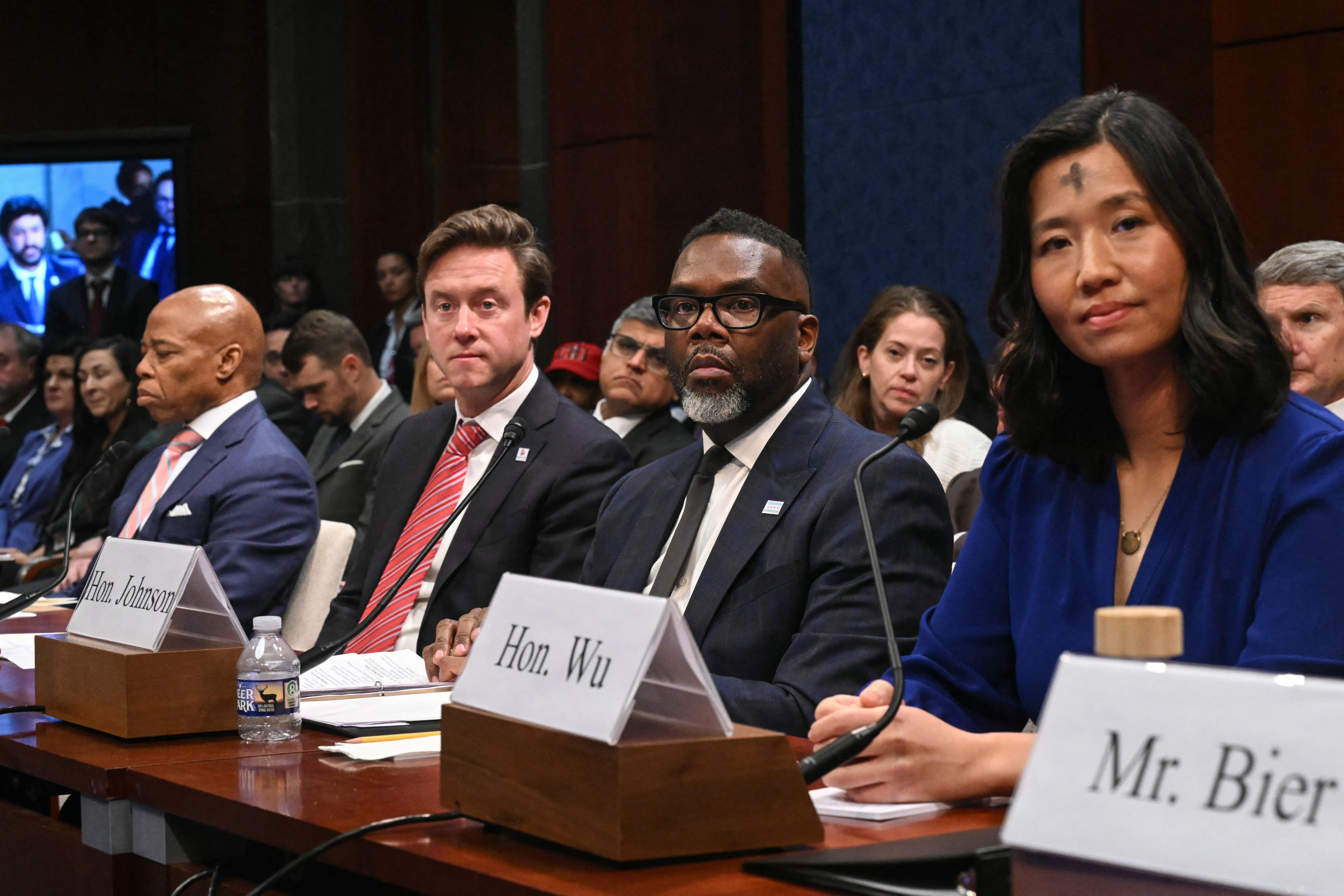
When Immigration and Customs Enforcement agents conducted raids across the country shortly after Trump’s inauguration, they started in the sanctuary cities of Chicago and New York, and the Department of Justice filed suit against these cities over their sanctuary policies. Last week, House Republicans accused the mayors of Chicago, New York, Boston, and Denver, who were called to testify about their sanctuary policies, of “welcoming criminals” into the country during a nearly seven-hour hearing on Capitol Hill.
But these cities’ ability to independently make decisions about how they treat their residents is a constitutionally protected right under the 10th Amendment, which prevents the federal government from requiring states to “address particular problems” or “administer or enforce a federal regulatory program.” For decades, lower courts and the Supreme Court have cited the 10th Amendment when ruling on legal challenges to immigration enforcement.
Today, over 100 states, counties, and cities across the country are considered sanctuary jurisdictions, and they’ve become low-hanging fruit for the government as it seeks to carry out Trump’s mass deportation promises. To better understand how sanctuary cities operate under the law and what’s commonly misunderstood about them, I spoke with Emma Winger, the deputy legal director at the American Immigration Council.
Our conversation has been edited and condensed for clarity.
Shirin Ali: How did sanctuary policies first take off in the U.S.?
Emma Winger: Jurisdictions have been exploring and implementing various forms of so-called sanctuary policies for at least a decade now. It’s hard to pinpoint why any one jurisdiction started formulating their welcoming policy or their sanctuary policy, but in general, a lot of this comes from two issues. One is that cities, states, and localities were concerned that cooperation between their local law enforcement and immigration enforcement authorities created fear and distrust among their immigrant residents—documented but also undocumented immigrant residents—and would discourage victims of crime from reporting crime. There was a move to limit that kind of cooperation and a decision not to use resources toward that sort of cooperation. Certainly, the first Trump administration marked a significant uptick in these kinds of policies, but there were welcoming policies that predated the first Trump administration.
How are sanctuary policies protected under the law?
The primary source for that authority is the Constitution. There’s a doctrine under the 10th Amendment that says that the federal government cannot commandeer states to enforce federal programs, including federal immigration programs. The Supreme Court has reiterated that in multiple cases over many decades. The basic principle is that states can choose whether to cooperate with immigration enforcement, and that’s been reiterated by the 9th Circuit Court of Appeals, but also the 5th Circuit Court of Appeals, the 3rd Circuit Court of Appeals, and multiple courts have reaffirmed that the 10th Amendment prevents the federal government from forcing states to cooperate with federal immigration-enforcement officers.
Many Republican lawmakers accuse sanctuary cities of breaking the law because they prevent ICE agents from identifying immigrants who commit crimes. Is that true?
I think the fact that it’s hard to identify what rule they’re breaking highlights the problem here. There is no federal law that compels states to cooperate, and that is because the 10th Amendment says that any such law would be unconstitutional. The federal government has actually repeatedly acknowledged that detainers [a voluntary request of local law enforcement to notify ICE before the release from custody of an immigrant who lacks permanent legal status] are merely requests of local law enforcement to hold somebody until immigration authorities can come pick them up and that, if it were a command, that would violate the 10th Amendment. There are federal laws that prohibit certain affirmative concealment of noncitizens, and that includes a criminal-harboring provision. But what we’re talking about here is not affirmative steps to prevent ICE from doing its job. And in fact ICE is free to—and does, routinely—arrest people in so-called sanctuary jurisdictions. What we’re talking about merely are policies that limit voluntary cooperation. There’s nothing in federal law that prohibits that.
There is one statute that is sometimes relied on—it’s identified by its U.S. code number, USC 1373. On its face, it prohibits states and local governments from enacting policies that limit communication about a person’s immigration or citizenship status when communicating with immigration authorities. Two things to say about that: One, it’s a very narrow law that literally applies only to information about immigration or citizenship status and does not apply to any other sorts of information. Secondly, several courts have found that the law, in and of itself, is unconstitutional under the 10th Amendment. But regardless of whether that law is constitutional, nothing about it requires, for example, local law enforcement to allow ICE to abide by detainers or assist ICE in making immigration arrests.
All four mayors, of Chicago, Denver, Boston, and New York, argued that their sanctuary policies make their cities safer. How does that work?
I’ve heard this repeatedly from local law enforcement through the work that I’ve done, and I’m also based here in Boston. Law enforcement has repeatedly seen that when the community at large views them as an immigration enforcement arm of ICE, then immigrant populations are less likely to cooperate with and reach out to local law enforcement. That includes immigrant populations, people who have status and those who do not. The result is that local law enforcement is less able to enforce criminal laws, which is, of course, their primary purpose.
Police and other law-enforcement officers have said that their work is much more difficult if the community does not trust them. When there’s ever been a suggestion after a raid, for example, that local law enforcement was somehow involved, people, particularly victims of domestic violence, stop reporting crimes because of a fear that ICE will be called or get involved. Witnesses are less likely to come forward and support a prosecution because, again, they are afraid. Law enforcement officers have frequently said that it makes it harder for them to protect the community, noncitizen and citizen alike, if they’re considered to be an arm of immigration.
Republicans have been attacking sanctuary cities by repeatedly citing examples in which an immigrant committed a crime, was taken into custody, but was released before ICE could take over, then ended up committing a violent act—see the Laken Riley case. What should we make of this argument?
I think there are a couple of responses. One is that the vast majority of undocumented noncitizens in this country do not commit crimes and do not present a danger to the community. If we set up a local law-enforcement system where those people are afraid to go to the police, then communities in general are less safe. Another response is that individual tragedies should not be used as a tool to criminalize and entrench immigration enforcement with local law enforcement because of the widespread harms that result from that. There is a danger in taking examples of, really, very rare tragedies and using them as a basis to create a national policy, because it misrepresents what the costs are of mandating that all local law enforcement participate in immigration enforcement.
Sanctuary cities offer some protection to immigrants by limiting information sharing with ICE, and Republicans have painted them as complete safe havens—but what can’t sanctuary cities do?
I think that’s a very important point, and I’ll start with saying that virtually all sanctuary or welcoming policies have exceptions, even within those policies for, oftentimes, people with certain criminal convictions. For example, the California Values Act, which has been upheld by the 9th Circuit Court of Appeals, has exceptions for noncitizens with really any felony conviction, as well as a range of other types of convictions. Most sanctuary cities have carve-outs like that, so it is absolutely not true that these jurisdictions are not, in some way or other, cooperating with federal immigration authorities. For the most part, there is some cooperation still happening, for better or for worse.
It is true that in all of these jurisdictions, ICE is continuing to do its job. It’s continuing to arrest people, including when people are released from criminal custody. ICE is also continuing to arrest people off the streets and showing up at people’s homes. All of that is happening across all of these states and localities that have some sort of limitation on cooperation with immigration enforcement. One mechanism that’s in place, regardless of any local policy, is that whenever someone is arrested and fingerprinted, those fingerprints automatically go to ICE, even in jurisdictions that have limitations on cooperation. Even in places where the police don’t affirmatively coordinate with ICE, it remains true that it is much easier for ICE to do immigration enforcement against someone who has had any contact with the criminal justice system, regardless of where they’re arrested.
What do you make of the DOJ lawsuits against Chicago and New York City over their sanctuary policies?
This administration has said that they are violating the supremacy clause—that is the argument they are making in those two lawsuits. That is not true. The courts have interpreted the supremacy clause to prohibit states and local governments from enforcing immigration law themselves, except under some narrow circumstances, as permitted by immigration law. But the supremacy clause has never been interpreted as a tool to force states and local governments to cooperate in federal immigration enforcement. However, it has been interpreted to limit when states can take certain affirmative steps—for example, prohibiting certain immigration detention and certain immigration contracts from being entered.
The supremacy clause has never been interpreted to mandate cooperation with federal immigration-enforcement authorities. Instead, it’s meant to limit the role states and local governments can play in federal immigration enforcement.