Sign up for Executive Dysfunction, a weekly newsletter that surfaces under-the-radar stories about what Trump is doing to the law—and how the law is pushing back.
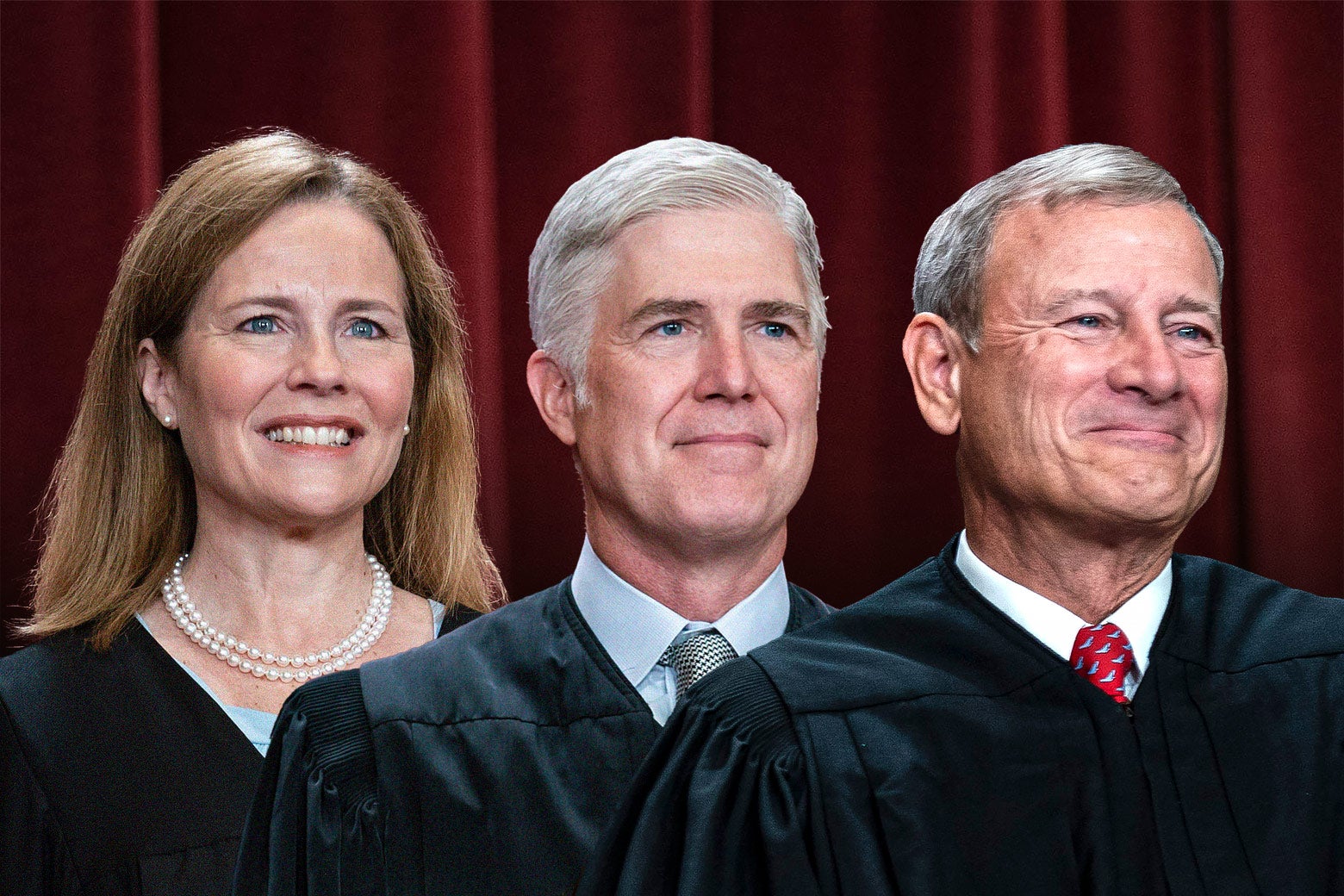
The Supreme Court’s 6–3 ruling against Donald Trump’s global tariffs prompted the president to berate the justices in the majority at a seething press conference on Friday. Trump declared that he was “absolutely ashamed of certain members of the court for not having the courage to do what’s right for the country.” He condemned these justices as “fools and lapdogs for the RINOs and the radical left Democrats” who are “very unpatriotic and disloyal to our Constitution,” adding that “the court has been swayed by foreign interests.” And he then singled out Justices Neil Gorsuch and Amy Coney Barrett, whom he himself appointed, as “an embarrassment to their families.” (By way of contrast, Trump praised Justice Brett Kavanaugh—who strongly dissented—for “his genius and his great ability,” noting that he was “very proud of that appointment.”)
This furious reaction should come as no surprise: The president has been pressuring the justices to side with him for months, warning that the United States’ economy would be “screwed” without the tariffs and calling the case “one of the most important” in history. But this strong-arming clearly failed. After nearly a year of indulging almost every presidential wish, the Roberts court drew a line. The court’s opinion evinces no concern about political backlash or economic ruin. Instead, the majority reflects a kind of serene intellectual indifference toward the consequences of this ruling, with both Gorsuch and Barrett far more interested in an academic debate over statutory construction than the potential for a presidential tantrum that could further destabilize an embattled judicial branch. And there is no indication that these justices ever wavered in their resolve to strike down Trump’s signature second-term policy.
On this week’s episode of Amicus, co-hosts Dahlia Lithwick and Mark Joseph Stern discussed the agreements and fractures among the six-justice majority, and all the ways in which the White House’s pressure campaign clearly fell flat, if it was experienced at all. A preview of their conversation, below, has been edited and condensed for clarity.
Dahlia Lithwick: A lot of people seem to think this is an incredibly fractured opinion with so many separate parts and concurrences and dissents. To me, the upshot of Chief Justice John Roberts’ opinion for the court is that this is just an unvarnished loss for Donald Trump. The liberals are not prepared to deploy the major questions doctrine, and the dissenters are big mad, but in the end, Trump just loses 6–3.
Mark Joseph Stern: I understand why it’s confusing. There is so much separate writing by justices on both sides. But the bottom line is that six justices say Trump’s global tariffs exceed his authority under the International Emergency Economic Powers Act. They all agree with the bottom line that IEEPA does not give the president power to unilaterally tax foreign goods by allowing him to “regulate” foreign imports in an emergency. There is a split within the majority, though. Chief Justice John Roberts, along with Gorsuch and Barrett, uses the major questions doctrine to bolster their conclusion. This trio says: We have a rule that when the president is claiming a major power of “economic and political significance,” he needs explicit statutory authorization. And IEEPA is not it.
But the liberals have never embraced that rule, which SCOTUS used to block much of President Joe Biden’s agenda. And in her separate concurrence, Justice Elena Kagan—joined by Justices Sonia Sotomayor and Ketanji Brown Jackson—says she still doesn’t agree with the major questions doctrine. Nor does she think it’s needed to get to the correct result here. But she also says that she agrees with “the bulk of the principal opinion’s reasoning.” So there is a solid six-justice supermajority here. This is not like the first Obamacare case where you had to count heads to find a majority.
There was also none of that weird, very visible horse-trading we saw in the Obamacare opinions—it was clear that justices were crossing their fingers and doing deals under the table. It didn’t feel like there was horse-trading here. There was a legitimate question about the major questions doctrine. The justices in the majority found slightly different ways to say no, but they were still saying no.
To me, that hints at the possibility that the six-justice majority firmed up very quickly after arguments. I think when the justices discussed this case at conference, it was clear that Roberts, Gorsuch, and Barrett were firmly against these tariffs. We speculated, at the time, whether the liberals would have to sign on to the major questions doctrine in order to get to a majority against the tariffs. Would Roberts team up with Gorsuch and Barrett to pressure the liberals into finally endorsing and legitimizing the major questions doctrine? It seems like that didn’t happen here because the three liberals held the line, and there is no indication they ever wavered. They said: We agree with the statutory interpretation, but we are still not on board with major questions.
If there had been the kind of horse-trading that we saw in the Obamacare case, maybe Roberts could have forced those three liberals into the major-questions fold. Instead, they stood in their own camp. That allowed those three to maintain their integrity and broader principles while still reaching the right conclusion.
CNN’s Kristen Holmes reported on Friday that Trump completely blew up in a meeting after learning of the ruling on tariffs. She said “he started ranting about the decision, not only calling it a disgrace, but started attacking the courts and at one point saying ‘these effing courts,’ but using the actual language there.” We’ve known for the last couple of weeks that Donald Trump is not feeling it from some of “his” justices. And this is actually a pretty serious moment to think about Donald Trump making these threats against the courts.
I don’t think Roberts, Gorsuch, or Barrett were at all cowed by Trump’s bullying before, and they won’t be now. He pressured them for months, insisting that he should be able to do what he wants, and that we’ll be a “poor country” if the court strikes down his tariffs. I don’t get the sense that the three conservatives in the majority cared at all. Roberts’ opinion is so crisp and confident—a classic “this is what the law is” ruling. To the extent there’s any wavering or disagreement between Barrett and Gorsuch, it’s an academic fight about the major questions doctrine! Gorsuch has a 46-page concurrence defending the major questions doctrine against the liberals’ criticism of it. Barrett has her own concurrence outlining her view that it’s a more modest rule of statutory construction; not as substantive as Gorsuch says. Yet they’re seemingly on the same page with Roberts about applying it here.
These justices were not scared watching Trump make these threats on CNN. They had their heads in the casebooks! Their brains were miles away. I do find that somewhat encouraging, because we obviously need a judiciary that can function independently of the executive branch and stand up to it when it breaks the law. And one gets the comforting sense that that is indeed what happened here.
It’s such a funny corrective to our constant complaint that some members of the Supreme Court have no idea what’s happening in Congress, no idea about the enormity of the insurrection that happened across the street a few years back, no idea about those rendition flights to El Salvador, no idea about anything. Today was their equal opportunity to have no idea of what’s really going on with Donald Trump, and weirdly, it saves the day? If he wanted this to feel like an existential threat to them, they’re not having it. They’re just going to do eggheaded judicial construction all day long.
In a way, that’s the most satisfying part of the opinion: They have their heads in the sand no matter what. It’s still going to be Professor Barrett at the chalkboard explaining the difference between a substantive canon and a rule of statutory construction. While Donald Trump absolutely fumes in the White House and unleashes the fury on the court, Barrett may never even see what he says.