Ed Fitzgerald remembers the first time he worried about the new neighbor, when he first got a glimpse of what was to come.
The man next door, Gil Kerley, had bought the building, an old eyeglasses factory in the Nob Hill neighborhood of Albuquerque, New Mexico, some months prior. One night, Ed saw someone sleeping in the doorway of the building. It was peak COVID times, and the building was under renovation, and the homelessness issue was not unknown to the people of Albuquerque, so Ed thought it would be neighborly to let Gil know.
But Gil didn’t seem concerned. Ed, an architect, recommended Gil put up a fence. Gil declined swiftly. Recalled Ed: “He just brushed me off, said he didn’t think that would look ‘welcoming.’ ”
Huh, thought Ed. Come to think of it, Gil had never seemed especially warm. Early on, Ed had crossed from his side of Jefferson Street Northeast, where his architecture firm stood, to Gil’s, and introduced himself. He found Gil gruff. “I could tell from the beginning he wasn’t interested in getting to know me,” said Ed. “He kinda kept to himself and didn’t really care to reach out in any communal way.”
The man sleeping outside appeared again, and again.
To the neighbors, at first, Gil seemed like one of them, and maybe more. A welcome new arrival, a fellow small-business owner with a vision to bring a nice addition to their little corner of Albuquerque: a used bookstore.
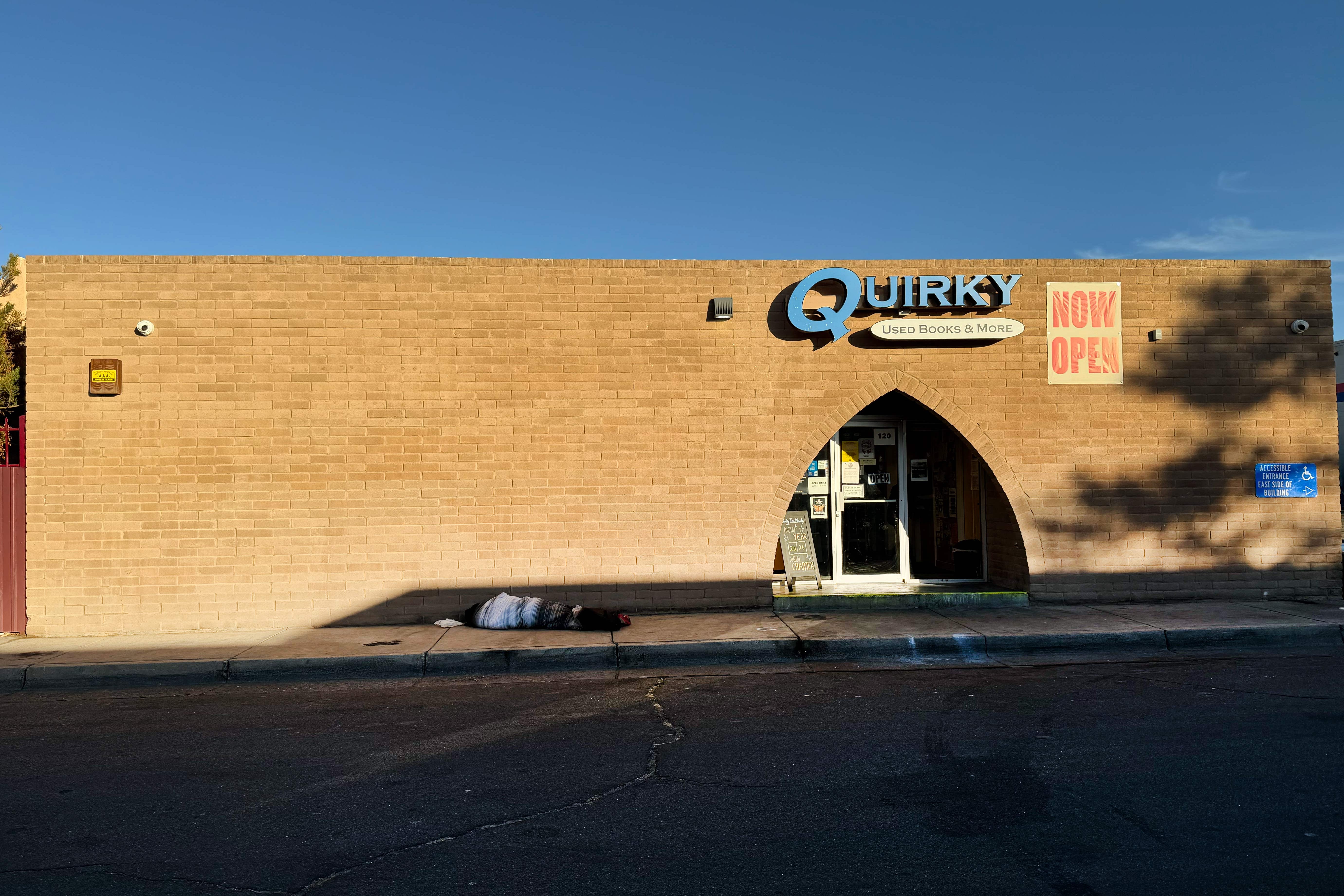
It was early 2019 when Gil first showed up, and in some senses, the timing couldn’t have been better. The old factory at 120 Jefferson Northeast, a sand-colored brick building with its distinctive arched entryway, had gone out of business, and quickly. That wasn’t the first closure in the neighborhood. Nob Hill had a reputation as a relatively well-to-do enclave, but here, in its outer reaches, the vacancies were becoming hard to ignore. Since Ed had moved in in 2000, he’d seen the departure of a hotel and a yoga studio, and a building go into bankruptcy.
Another neighbor, Alfredo Barrenechea, owner of Absolute Investment Realty, which shared a wall with the glasses-factory property, represented the building’s seller. Nothing about the transaction struck him as strange. By April 2019, the paperwork was signed, and they had a deal. 120 Jefferson was Gil’s.
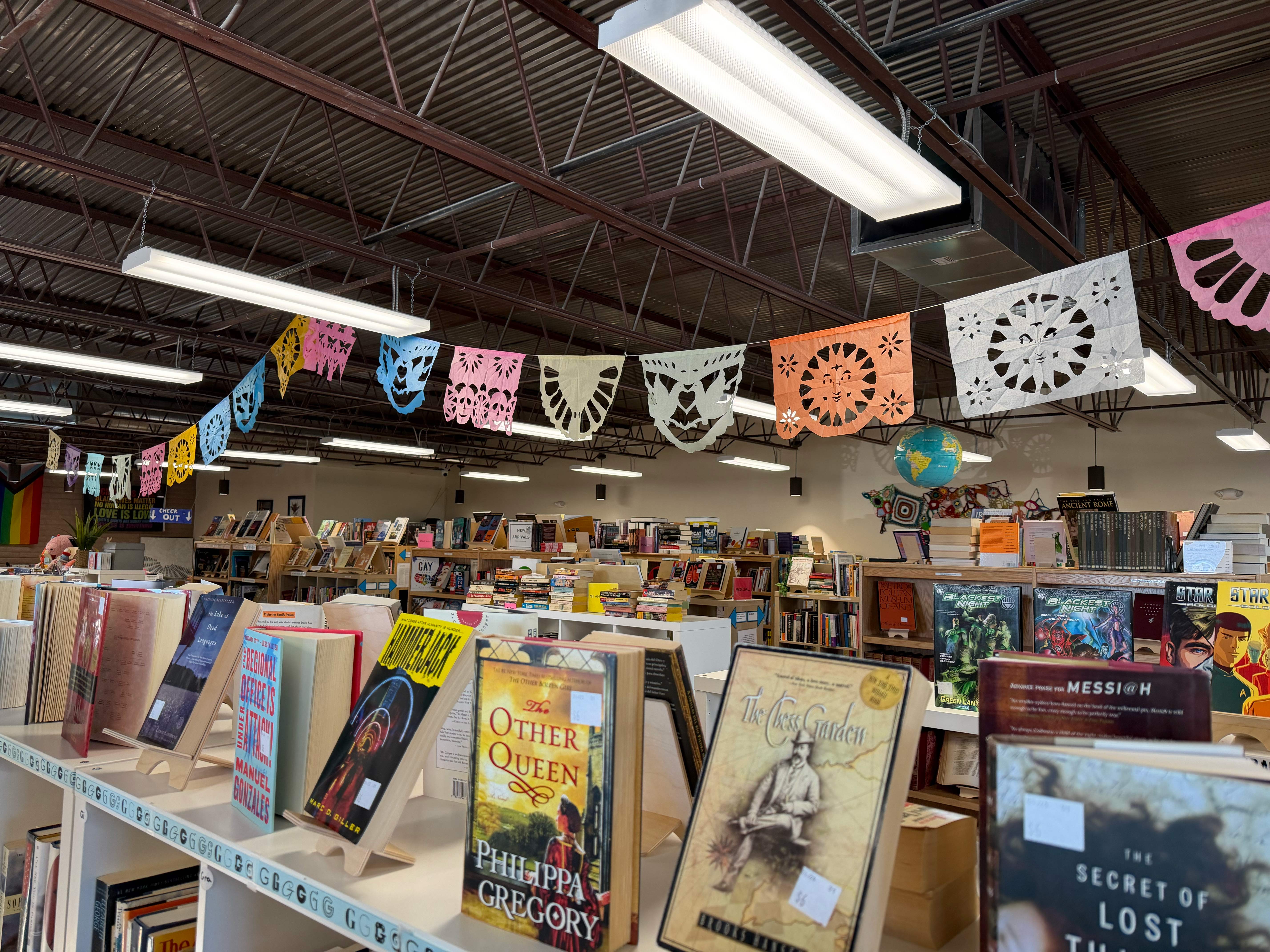
His arrival seemed like a saving grace. He hired an architect, and they began to renovate. He hired a local woodworker to make shelves. They pulled down the drop ceiling, and repurposed old workstations as the sales counter, and did extensive rewiring. Gil was pouring money into the renovation, into things he probably shouldn’t have, putting extra-nice butcher block in the bathrooms. He put up a lighted sign for the new establishment: Quirky Books.
This seemed like a classic tale of gentrification: out with the manufacturing, in with the charming culture-hub business. Good for foot traffic, for property values. “It looked great. All of us had optimism,” said Alfredo, who has owned in the neighborhood since 2007. “When someone has a real sign, that’s a good sign.”
Then as the renovations wore on, the staff at Absolute Realty too noticed someone camping behind Gil’s building. So they also reached out to Gil and told him. “My manager would go talk to Gil and say, ‘Hey, I don’t know if you know, but there’s a homeless guy here, filling up your place with stuff,’ ” recalled Alfredo. “And he’d dismiss us.”
So it was one homeless person in the front. That was just city life. The neighbors weren’t unsympathetic, nor were they impractical. But then there was another man in the back. The neighbors began to talk, especially as the full tilt of Gil’s intentions became clearer. Their alarm grew. Looking back now, they realize they were actually underreacting.
“Believe me, we’re pretty liberal people, probably all Democrats, probably all compassionate people that like to help other people,” said Ed.
“This is not MAGA-land,” said Alfredo, the realtor.
“We are not against the homeless,” said Sarah Ferrell, a massage instructor wearing a “Chinga La Migra” T-shirt, whose Albuquerque School of Healing Arts also shared a border with Quirky Books.
Everyone in the Nob Hill neighborhood wanted me to know: They were good people. They cared about their neighbors, even the increasing number of homeless ones, in the broad sense. But they couldn’t stand for what was happening at Quirky Books, which had changed dramatically since those fateful days in 2020. They had now been in and out of courtrooms, in city council meetings; they had been demonized by friends and local activists. They couldn’t understand how they were the villains.
For a while, they thought maybe their new neighbor just had a soft touch, and a large heart. For a while, they thought he was principled if misguided, and not the best at explaining himself. That was before they found out about his past, and before they were living in the midst of an encampment whose population, in just a handful of years, had grown nearly 10 times, plus dogs and barbecues and furniture and more. Now, they felt like they had been taken hostage by one man’s revenge fantasy that threatened to burn the entire neighborhood down.
This was all not Gil’s plan from the beginning—he wanted to be clear about that.
In Madison, Wisconsin, as a young man, he had owned a used bookstore. His arrival on Jefferson Street was not an attempt to restage that, exactly, but more a culmination of a life’s work. Gil had been an early adopter of e-commerce after his old store folded, and he made a nice living selling books on eBay and Amazon. In 2019, when he bought the building that would house Quirky, he was nearing 60 years old, finally making his way back to brick-and-mortar.
He wanted the shop to be a true community space, where all were welcome. He had visions of co-working happening at desks in the back. And he was most of the way done with the renovation when the COVID pandemic began, and then all of a sudden, it didn’t seem so smart to dedicate half of the 4,000-square-foot store to cohabitation. He started over.
In the doldrums of COVID, Gil would come around to check in on the renovation. Throughout those months, he got to know the guy who frequented his alcove, the one Ed had warned him about. He was a man named William, and he would sleep rough—without a tent—in the store’s entryway. He had gone in and out of homelessness, struggled with addiction. He wasn’t causing Gil any problems, Gil thought, so he let him stay. They developed an understanding: William would keep an eye out, an unofficial security guard of sorts. And soon he cut his friend Reyne in on that duty, too. Reyne became the guy camping in the back.
William’s health began declining rapidly. He wanted to get back to his family in Virginia. Gil bought William a Greyhound ticket and got him on the bus home. William died not long after, in his 30s.
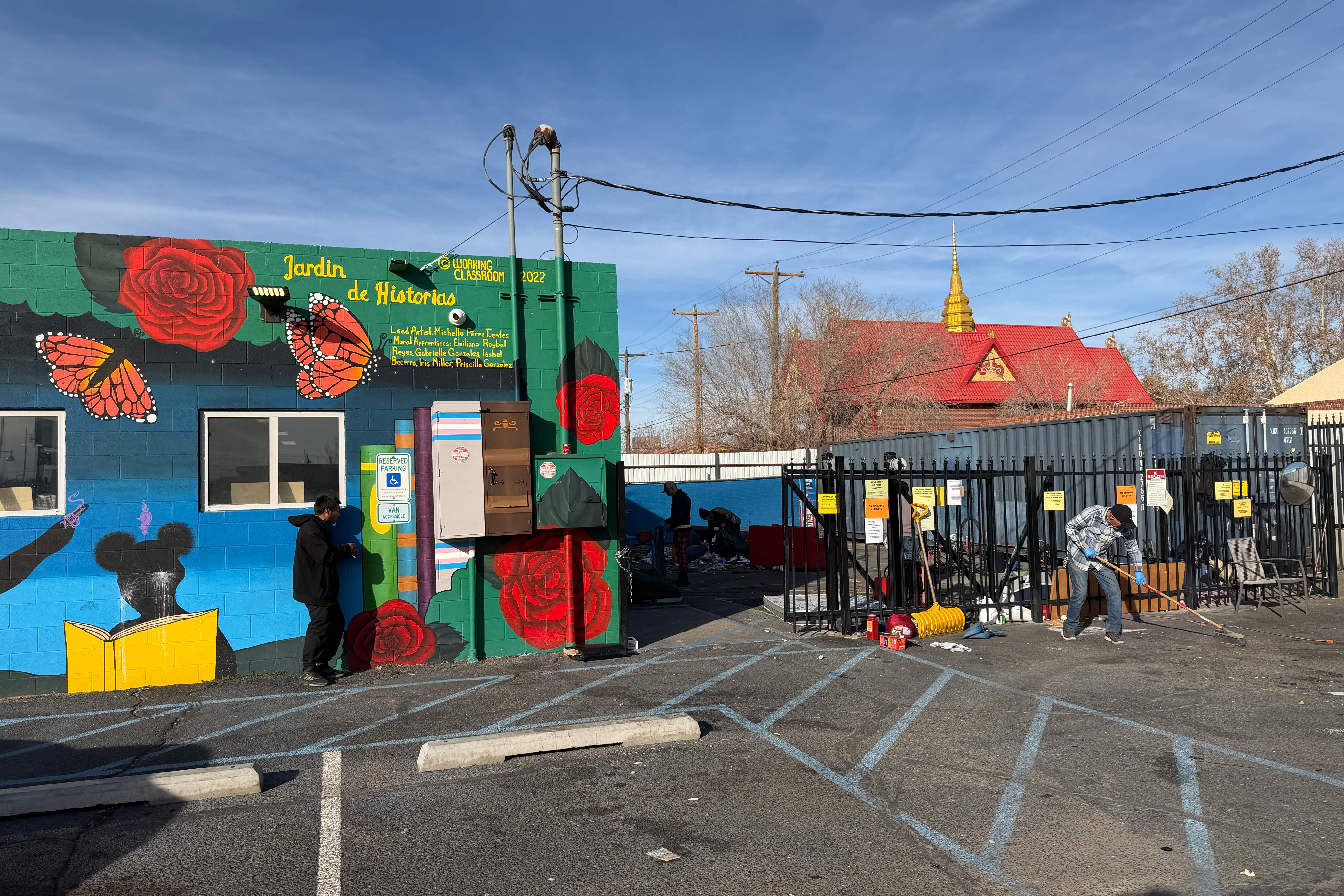
Reyne took over as night watchman, with his tent on the asphalt in the parking lot behind. He would keep an eye on the space after hours and sweep up around the area when it needed it.
The COVID-era re-renovation was underway, and in the meantime, Gil had been getting back into activism, another interest of his youth. He joined up with a group called Street Safe New Mexico on the recommendation of a friend. The group worked up a policy to try to address a homelessness crisis that seemed to be spiraling out of control in Albuquerque, but also in cities all over the country. Gil soon became one of a small group of advocates that spanned a surprisingly broad swath of the political spectrum: one conservative Christian registered Republican, a couple of Democrats, and him, a member of the Working Families Party. “Tripartisan,” he joked.
Together, they worked up the proposal for Safe Outdoor Spaces, aimed at allowing managed, secure areas for people to pitch tents in vacant lots to reduce illegal encampments. In June 2022, the proposal passed the City Council narrowly, on a 5–4 vote. The regulations allowed for safe, sanctioned camping for up to 50 people with amenities like security and sanitation.
At the same time, Gil was finally ready to debut the bookstore. In April 2022, three years after he bought the building, the door of Quirky Books swung open, with a strong commitment that it would be a community space for all, with no exception for homeless people, whom Gil dutifully referred to as his “unhoused neighbors.” He installed a Free Fridge, a pantry where people could access donated food.
Safe Outdoor Spaces was not ready to debut. Almost immediately, the council passed a one-year moratorium to stop it, which was subsequently vetoed by the mayor. From there, the council freighted the policy with stipulations that made it difficult to actually satisfy. One Safe Outdoor Space did open in the district, on a nearby church property, with 16 tents. But it was the only one. The city of Albuquerque, like so many others, was ratcheting up its sweeps of encampments, a criminal crackdown on public camping that turned life from difficult to nearly impossible for the city’s most vulnerable.
So when Reyne told a few friends about the safe passage at Quirky, Gil figured it was no big deal. “Spend the night, pack up in the morning,” he’d say. Some people, like Jeremy, who was camping in the nearby Firestone Tire parking lot, just hung out during the day; others slept over. Gil didn’t ask too much, just that they have their tents down by 10 a.m. During business hours, they were welcome to use the store’s water fountains, its bathrooms, its electricity, to read in the reading nook, or nod off, if need be. At 6, he’d lock up and head home.
It was a small enough group, and over time, Gil felt like he developed personal relationships with all of them, his unhoused neighbors.
He did not develop relationships with the housed neighbors, who had grown increasingly concerned.
Gil never went over and introduced himself to Sarah, co-owner of the Albuquerque School of Healing Arts, which shared a lot line with Quirky. Nor did he drop by Absolute Realty to introduce himself to Alfredo.
Those neighbors were beginning to find more and more evidence of the unhoused neighbors on their own properties. Trash, needles, bottles of piss, the detritus of vulnerable lives lived outdoors. They were having to do more cleanup than they once had. They were sympathetic to the concept—this was a liberal neighborhood, after all—and they were trying to be tolerant. Unpleasant stuff, not dangerous. But they were starting to get annoyed and confused about what kind of small business, exactly, Gil seemed to be running here.
Was it Gil’s fault? By the time I arrived in Albuquerque several years on, they were past annoyed, past concern, well past neighborhood civility.
“He doesn’t seem to worry about money like most small-business owners,” said Sarah.
Alfredo said, “He’s absolutely the worst neighbor I’ve ever had in my life.”
Let’s just say that for the first year, maybe even the first two, it wasn’t that noticeable.
“We treated it as an experiment,” Gil told me. Compared to the overbearing shelter system, which broke up friends, mandated sobriety, lacked privacy, prohibited pets, and offered insufficient storage, Gil wanted to have a light touch. He also tried to be flexible, realistic. Eventually, he came to implement certain rules, like requiring that campers be referred to him first. He moved keys for the bathrooms behind the counter. When the extension cords running to the back popped the circuit breakers, repeatedly, he tried to curtail electricity usage in the camp. He plunged toilets and snaked drains. “I didn’t expect it to be easy,” he said.
Mostly, he insisted, the unhoused neighbors were vigilant stewards, and helped with sweeping and trash pickup and the like; “99 percent of the time it was working great,” he said.
Meanwhile, his commitment to being a values-driven business drew supporters, who began to donate supplies, and books—so many books, in fact, that every book he sold came via charitable donation.
But as fast as Gil was running to accommodate new arrivals, the city’s population of homeless people was growing even faster. Albuquerque’s homelessness problem, already profound, was getting worse all the time. A recent “point in time” count, as they’re called, the famously incomplete snapshot of how many people are homeless in a city on a given night, clocked the city’s homeless population at 2,500. Most advocates believe the real number is at least 5,000. An analysis of emergency room visits identified 10,500 homeless New Mexicans in 2022, with Albuquerque’s Bernalillo County ranking as the state’s county with the most homeless people. In a city of 500,000 people, 1 in 100 people might be homeless, maybe even more. Meanwhile, the shelter system offered 1,300 beds.
Still, the city was cracking down on campers. Perhaps following the leadership of California Gov. Gavin Newsom, perhaps powered by the 2024 Supreme Court decision Grants Pass v. Johnson, which effectively allowed cities to outlaw public camping, Albuquerque began a regime of sweeps, actively dismantling encampments—soon after, they outlawed public camping altogether. Per a 2024 ProPublica report, crews “visited more than 4,500 locations where people were camping, more than double the number from the previous year.”
And so, more than ever, homeless people were seeing their essential belongings, like medications and identification and EBT cards and everything they own, stuff that might make it possible to get a job or find housing, thrown in the trash with little notice. Which of course made them more stuck and more vulnerable than ever. Sometimes it was fatal.
The city’s primary shelter, meanwhile, was notorious. One caseworker who worked in drug detox said: “It was shocking, to say the least. The facility is the old city jail and folks are housed in large dormitories with very little safety or supervision. I wouldn’t even recommend my clients go there.” There is little privacy, it is miles out into the volcanic grasslands of the plateau, it did not allow pets. “Deplorable” was how the local press described it.
The need was just too great, thought Gil, to stand by and do nothing. “Something has to be done,” he said.
The drugs weren’t helping. For a long time, in Albuquerque, it was methamphetamine, a reality well known from the hometown TV show Breaking Bad. Then meth was joined by the “blues,” the street name for fentanyl pills, which were even cheaper and stronger. One pill could be purchased for as little as $1. It would be naive to say that wasn’t an accelerant. When the Trump administration recently announced the largest fentanyl bust in American history, it did not surprise locals that it was centered in Albuquerque.
So acute was the situation that Albuquerque had a neighborhood, the International District, a rival to Los Angeles’ Skid Row or San Francisco’s Tenderloin, that was locally called the War Zone. Traditionally, the boundaries of the War Zone were San Mateo to Wyoming streets on one axis, Gibson to Central Avenue on the other, a district of flophouses, gang violence, and open-air drug markets.
Quirky Books was not in the War Zone. But it was about half a mile from where the War Zone semi-officially ended.
“In the War Zone,” said one caseworker who had worked in the neighborhood doing drug detox, “the cops have given up. The authorities have given up.”
But it wasn’t like Albuquerque was doing nothing, or nothing but punishment. The Albuquerque Community Safety department has been cited favorably by New York City’s Democratic Socialist Mayor Zohran Mamdani as a model of the “full range of tools” that are needed to improve public safety and “successful precedent in other parts of the country.” ACS has responded to 100,000 calls for service. It’s thrown money at the issue. The Westside shelter got new management, and millions of dollars in renovations, and a rebrand as “Gateway West.” The women’s shelter and the detox facilities won plaudits, too.
And yet still, Gil’s camp was growing.
Reyne, Gil’s deputy, vouched for Jeremy to stay, and so he started sleeping there, too. Soon, Gil was selling Jeremy’s art in his store. Janet came down, and when her son Evan went through a painful breakup, he sought her out and joined as well. Then there was Birdman, and Carlos. Some stayed for a while, left, and came back. Who exactly the core crew was depended on who you asked. “This is the best bookstore ever,” said Mo, who had lived there a while before Gil had to ask her to leave.
There were new challenges—even Gil could admit that. “Reyne definitely did better when it was just him camping back there,” he told me.
The housed neighbors began to see things, and hear things, things they hadn’t seen or heard so much before. Every once in a while, Ed would see drug dealers, or people having sex in cars, or people having sex in front of the store. The amount of stuff accumulating began to reach out from behind the store and obtrude into plain view; the amount of stuff disappearing from their properties was increasing. Sometimes, there was yelling and shouting or people giving haircuts in the street.
At the meditation center, Sarah found people bathing with her hose nightly and leaving the water running, cutting into water lines, and making warming fires close to the building. By 2023, she had installed four security cameras. Not long after, she installed more.
There were more needles around the neighborhood than there had been, and the foot traffic was not what you’d expect a used bookstore to have brought. But Gil was steadfast. By April 2024, he’d implemented 11 rules for campers: no drugs, keep clean, etc. He insisted that the uptick in trash and threats and break-ins was a result of the city’s larger failure, more of a coincidence than anything. It had nothing to do with his camp. “They’re upset about unhoused people in general,” he insisted. He himself had been the victim of violent crime before. He was sure it had been unrelated.
The neighbors weren’t so sure. “The store is closed from 6 p.m. until 10 a.m.,” pointed out Sarah. “How many times do those people need to use the bathroom in that time alone?”
They respected what Gil was trying to do, they insisted. “I have compassion for the wanting to do good,” Sarah said. “But are you really gonna take us all with you without our permission?” “This dude sees the world a little differently than us,” Alfredo worried. By summer 2024, said Sarah, things had gotten out of control. The neighbors began reporting things to 311 religiously. Sometimes they called the cops.
In July of that year, the Code Enforcement division of the Planning Department dropped in to inspect and cited Quirky for code violations: litter, outdoor storage, tents erected at a place other than a campsite. In September, it came back and failed Quirky again. In October, it returned, failing Quirky a third time. It brought an administrative civil enforcement case against Gil and levied a fine.
Gil found a Santa Fe firm and got legal help pro bono. He was steadfast that all he was doing was helping, that the objections were cosmetic, and overblown. The case got pushed back, as they tend to do, and the camp continued. In the meantime, the city pushed Gil toward an off-ramp. They encouraged him to formalize his camp by making it a Safe Outdoor Space, the very program he’d had a hand in creating barely two years prior. “I reviewed the sections of the IDO pertaining to Safe Outdoor Spaces,” Gil wrote in a subsequent legal document, “and determined that the burdensome regulations would prevent me from doing so.” To comply with the city’s onerous stipulations, he calculated, would cost him at least $100,000 a year.
No, Gil liked his chances in court instead. Could he really move a camp for homeless people into his neighborhood? He thought so. These were his private-property rights, after all. It was righteous, and it was legal—he was sure of it.
And then on May 1, 2025, he lost, in a mostly conciliatory finding.
“Mr. Kerley is an altruistic idealist. Were the world full of idealists such as Gillam Kerley, humanity would likely solve broad-based societal problems without the need for the blunt instrument of government,” said hearing officer Rip Harwood. “The reality, however, is that altruistic idealists are few and far between in this world.”
All but the litter charges were thrown out, and even that was deemed de minimis. The fine was suspended pending compliance.
A few weeks later, represented pro bono by the Institute for Justice, Gil appealed the ruling. He posed for portraits on its website. He wanted to escalate the case, claiming his U.S. and New Mexico constitutional rights were being infringed upon. The camp continued, pending trial. The unhoused neighbors could stay.
The housed neighbors couldn’t understand it. This had gone way beyond altruism, they thought. There had to be some other motivation. They began to do research on their neighbor, their abutter. Who was this guy? Oh no, they texted each other—look at this.
Gil Kerley was born in 1961 in Rock Hill, South Carolina, in the still-segregated South, the only child of a schoolteacher and a college econ professor. No one would accuse them of being radicals. “My father was liberal on racial issues. My mother was not,” said Gil. But they all disliked the Vietnam War, which they, like many American families, watched coverage of regularly on TV.
After high school, Gil set out for college, up north at the University of Wisconsin in Madison, where he got his first real taste for activism. In his first month on campus, he got in with the anti-apartheid protests, and ended up in a demonstration at the university’s board of regents that nearly ended with him in handcuffs. And when Jimmy Carter announced the return of the selective service in 1980, in response to the Soviet invasion of Afghanistan, Gil, still an underclassman, decided to take a stand: He refused to sign up.
Gil became a face of a loud and popular movement of noncompliance. By 1982, Selective Service Director Thomas Turnage reported that more than 500,000 young men had failed to register for the reinstated program. That same year, then-President Ronald Reagan, who had initially campaigned against the reinstated selective service, decided he would keep it. His Justice Department would prosecute refuseniks.
In 1982, Gil was indicted. The felony statute allowed for jail time of up to five years, and a fine of $10,000. With half a million intransigents to choose from, the Reagan people came down hard on 18 of the most outspoken, including Gil, who had ascended to being regional director of the Committee Against Registration and the Draft. Gil spent the bulk of the 1980s, his 20s, in and out of courtrooms. The case was delayed again and again, escalated to higher and higher courts. He wanted to go all the way here, too; he came to savor a good appeal. He went on to graduate studies and running the bookstore and living his young life. Initially, it seemed like he might make out fine, even as he insisted on pleading guilty. In a stroke of luck, he drew a judge known for leniency.
Then that judge died. The judge who took over, Judge John C. Shabaz, was an archconservative. And when the case was finally decided, Gil got the single harshest sentence of any participant: three years in Leavenworth Federal Penitentiary, plus a full $10,000 fine, long after the Justice Department had abandoned the policy that singled out vocal nonregistrants. The rest of the cohort got house arrest, or their charges dropped. Shabaz singled Gil out, as a lead organizer, for “aiding and abetting.” In July 1987, Gil, then 26 years old, donned a T-shirt with the phrase “Justice is a constant struggle” and set off for the clink in Kansas.
Gil didn’t feel regret. “I felt like I was making a difference; I felt like it was important to do,” he said. “It helped keep the federal government from bringing back the draft.” He did four months before the rest of the sentence and the fine were finally vacated on appeal.
Gil returned to Madison and ran the bookstore until it ran out of money. He switched to selling antiques and collectibles, renting space in antique malls, and got back into used books from there. During the early days of selling books online, he bought publisher overstock and made a nice living on eBay before Amazon put the squeeze on retail prices.
Years passed. Then, in 2004, he was staring down a five-year lease renewal on his warehouse space in Madison and decided Wisconsin was simply too cold to continue. He traveled around the American Southwest—San Diego, Austin—before settling on Albuquerque, where he had a family friend. He set back up selling online.
He was burned out on activism, and mostly stayed out of it.
Then his mother died in 2018, and he inherited some money. He went shopping for real estate, first buying out the warehouse space he had been renting, then turning back to the idea of reviving the bookstore.
And so he did. Gil continued selling the most sought-after titles on Amazon, and on Biblio. In the store, he had 24,000 titles—not the rejects, exactly, but some of the lesser spines. “Our inventory,” reads the website, “is designed to be affordable, with the overwhelming majority priced at $10 or less.” A number of the books were $1, or free.
It all started to make sense to the housed neighbors. Maybe Gil wasn’t just a bleeding heart. He was an anti-authority zealot, made recently rich, with an axe to grind. Maybe this was the plan for Quirky Books all along.
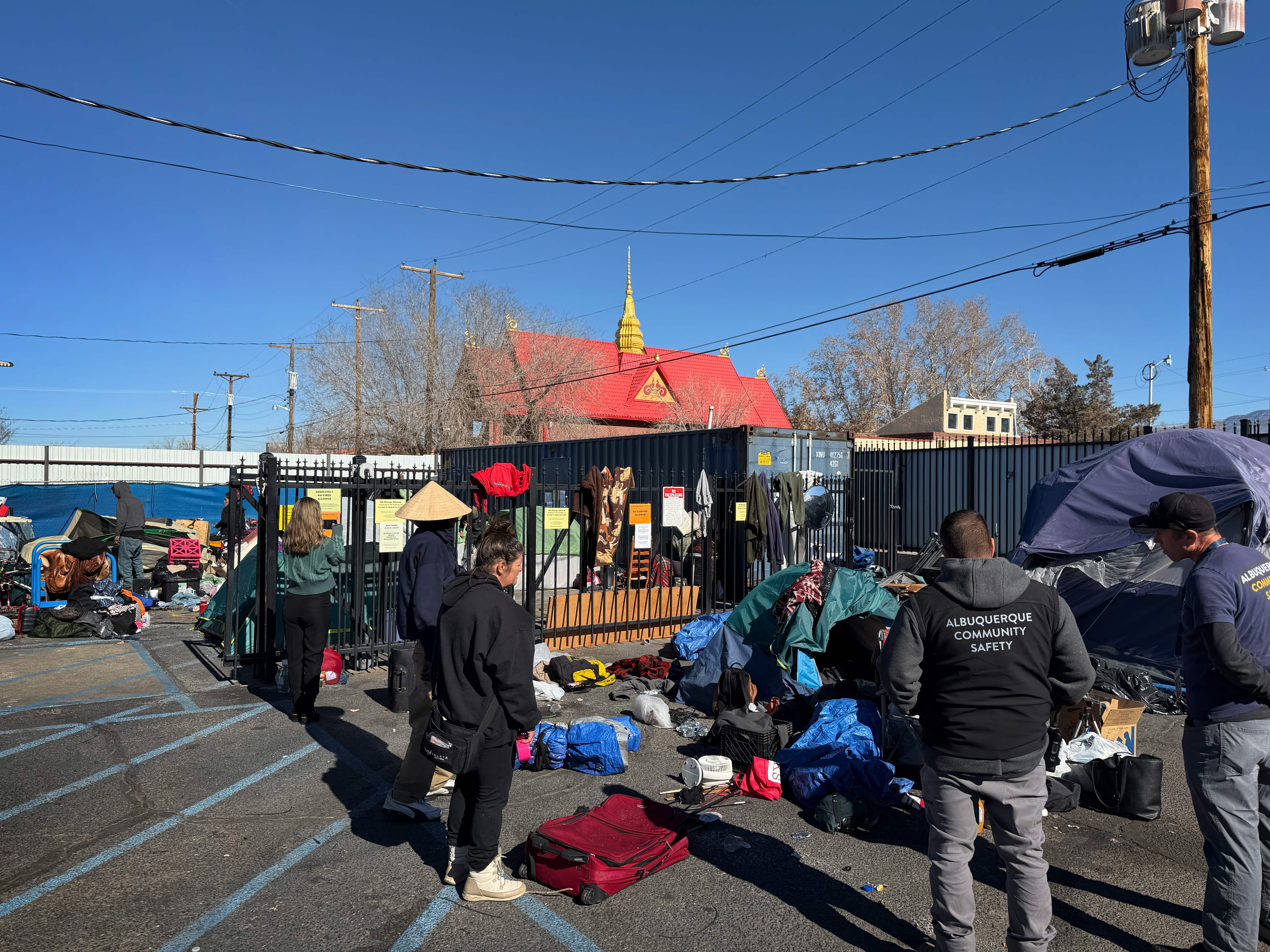
By summer 2025, it was even more out of control, said the neighbors, way more than before. The population had surged again, sanctioned or not. Outside Quirky, Alfredo was threatened by someone with a machete, he said. On another occasion, he was menaced by a man with a samurai sword. Someone ran through his parking lot with a gun, in the midst of a mental-health crisis. One time, someone threw a Molotov cocktail, made of a plastic bottle full of rubbing alcohol and a used tampon, which was charred at the end. A tenant of Ed’s fled as a guy chased her and tried to break into her apartment.
“I saw two men beating up another man by punching and kicking him and ripping off his clothes, and the individuals residing in or visiting the Quirky Books encampment began cheering as the fight escalated,” said Sarah.
“People confuse discomfort with danger,” said Sawyer Merrell, one of the two employees who worked at Quirky Books. “This was not a good neighborhood to begin with,” said Lily, the other employee.
“It was never like this,” said Alfredo.
Had the War Zone crept into Nob Hill? Or did Gil invite it in? It certainly seemed as though word had gotten out, and it had become a new front, where people could leave their stuff, or meet friends, or pass through. For a long time, the housed neighbors had felt like the city had abandoned homeless people. Now they felt like the city was abandoning them.
They complained of the smell, a combination of all of the earthly belongings of the residents, the burning of fentanyl, and urine. In July 2025, Code Enforcement came back, and socked Gil with yet another notice of infraction, 10 different violations over seven different dates, an escalation of the same code violations he had been largely acquitted for earlier, good for $35,000 in total penalties. He appealed that too.
The other property owners began losing money. “Our sales started getting hit big-time,” said Braydon Cox, manager of Score 420 Nob Hill, the weed store on the corner. “We may have to close this location.”
Sarah lost one tenant at the meditation studio in July; another threatened to move out soon after. Ed worried about losing a tenant at his second building, and paid to install more security. Sarah paid $15,000 to rip out the chain-link fence separating the Healing Arts center and Quirky, which had been cut into repeatedly, and replace it with 80 feet of reinforcement. And in the moment her fence was down during installation, her HVAC unit was stripped of all of its copper and aluminum, another $12,000 expense. Alfredo also went up with larger metal panels separating his parking lot from Quirky.
“The whole place is fucking fortified,” said Alfredo. He implemented a new security protocol for his employees, who were instructed to leave the building by 5 p.m. sharp and lock the whole place down.
The drug problem seemed to be getting worse, which even the campers confessed to. A man with a green Pontiac that didn’t run began selling drugs out of the car. At night, after the bookstore closed, he, sometimes with the help of friends, pushed the inoperable vehicle into the lot at Quirky and slept in it. Before Gil arrived in the morning, he pushed it back to the street.
That guy wasn’t a permitted camper, insisted Gil. And wasn’t the drug problem worse everywhere?
By now, the cops were getting called constantly.
An Albuquerque Police Department commander, Ray Del Greco, said the APD responded to 235 calls at or around Quirky over the course of a year. On Oct. 1, 2025, the department launched an undercover sting there.
Officers managed to buy $40 worth of “blues” in one transaction, and $20 worth of “shardies”—crystal meth—in another. That resulted in seven arrests, including one for an outstanding warrant. They came back in December with undercover officers and got another person for selling $20 worth of “clear.”
According to court documents, throughout September and October, they went on an arrest spree, mostly for drug paraphernalia and outstanding warrants. They set up clandestine camera monitoring from a public location. What they found: “The camera captured footage of numerous dogs who appear to be owned by residents of the encampment roaming the encampment and adjacent public and private property without a leash or an owner in sight. One dog defecated on the property without an owner present to pick it up.” And: “The camera captured footage of an individual from the encampment with his buttocks exposed.”
To the housed neighbors, this was resounding. To Gil: “Four fentanyl pills and less than a gram of meth?” All those cop cars for outstanding warrants? All that surveillance for a guy mooning the camera and a few dogs off leash? Plus, Gil insisted, as he always did, that those were trespassers anyway, not his approved unhoused community of neighbors.
Who would trust the APD anyway? The department had been rocked by corruption scandals, one after the next, and operating under a Justice Department consent decree for over a decade.
Maybe, actually, they were setting Gil up. And then Gil’s lawyers acquired lapel-cam footage from the APD showing that an officer had indeed actively swept people camped on the sidewalk onto Quirky Books property the very same day the city brought its first Code Enforcement violation in 2024. “The people who own this property, they don’t care if anyone stays on their property, we’re OK with that, right? That’s their property,” the officer can be heard saying.
In early November, the city filed suit against Quirky, asking a judge to declare the bookstore a public nuisance. That also seemed suspicious to Gil, coming right after Democratic Mayor Tim Keller was sent to a runoff with conservative challenger Sheriff Darren White. Indeed, in their next debate, Quirky was mentioned.
And the camp grew on. Gil set the formal limit at 12 tents, but there were “trespassers” aplenty, turning up after close, leaving before open, or not.
Maybe it had nothing to do with the unhoused neighbors, or with the housed neighbors either. Maybe it was the city of Albuquerque versus Gil, and the entire political apparatus punishing him for being vocal about their failures. “It brings back some definite memories,” he told me. “Anytime you’re trying to make political change, there’s gonna be resistance.”
Three days after that exchange, a man named Gregory Antone had been at the Quirky encampment, left, and returned. An argument broke out. According to security footage, Antone went to his car, retrieved a gun, and pulled it on the other man, who drew his own gun from his waistband, shot, and killed Antone. The shooter fled.
Neither Antone nor the shooter was a Quirky camper, and the shooting took place down the street, pointed out Gil. “Unrelated,” said his lawyers, which was cold comfort for everyone else.
Then, in December, Gil lost the appeal. Judge Daniel Ramczyk upheld a fine and rejected his argument that they had a right to provide shelter, stating it was “not supported by any legal precedent and actually contradicts available case law.”
A few days later came the fire. Around 9:30 p.m., just before Christmas, a fire sparked up in one of the tents. It was cold; maybe someone was lighting up. Then there was an explosion—likely an aerosol can. Ed called the Fire Department, alerted the neighbors. The fire was right beneath a power line, and the transistor charred. Alfredo raced down to move an old truck he kept in the Absolute Realty lot, fearing it might catch. His office lost its Wi-Fi. The Fire Department put out the flames, but not before five tents burned, taking with them everything inside.
One of the campers thought maybe it was the housed neighbors who’d started it, but no one else seemed to think so. Reyne told Gil he knew who had done it, but Gil wouldn’t let him punish the accused camper without proof, and anything close to that had turned to ash.
Surely, the housed neighbors thought, enough was enough. Gil would call it quits now—afraid for his business, of losing everything.
“It was a very traumatic thing,” Gil said of the fire. Not for him, he clarified, not for the business, but for the unhoused neighbors. “Our whole purpose was to give people a place safer than the street, where the stuff wouldn’t be destroyed by the city.”
Instead, Gil also went up with a fence, sort of. He formalized the process even further. He asked all the 15 sanctioned campers to move all 12 of the tents into a gated area in the lot, tucked closest to the store and farthest from the street.
By now, rumors were ripping through the neighborhood.
“I think he was having them pay to live there,” said Braydon, at the weed store. “I think he was getting paid by the homeless people.”
How was he paying his insurance? How was he affording these lawyers? The neighbors did even more research, and circulated their findings. When they found out he owned other warehouse space in the city, they figured they were up against something deep-pocketed and immense.
Maybe he was in it for the fame? The bookstore was getting more exposure. By Gil’s own accounting, sales had doubled in the past year. “I think part of the motivation has to do with, he now has an Instagram site with a lot of followers. I think it’s a notoriety thing,” said Ed.
They thought he was still hung up on getting even with the government. They wondered if after the unfair prison sentence, he might have wanted revenge. “He started out having this mission, doing noble things,” Sarah said. “But this one is somewhat unreasonable. He’s got a chip on his shoulder versus the government,” she decided.
“A lot of this is ‘Stick it to the man, I’m gonna do what I want, and I’m gonna see how far I can push it,’ ” agreed Alfredo.
“He wants to win this battle with the city; he wants to win in court. It’s become this personal quixotic quest for him,” agreed Ed.
They began to wonder if this had been the plan all along, not to reestablish his bookstore, but to restage his fight with the man. To get one more shot to fight city hall, and win.
Now, the housed neighbors weren’t just losing business, they were losing friends. Throughout November and December, people had come to Quirky and placed sticky notes on the door saying the store was not a nuisance. In affidavits submitted to the court, supporters noted that Gil’s was the very last place that was safe and decent and dignified for the city’s worst off.
“There’s a lot of blind support for this,” said Alfredo. “We even got into it with some friends of ours.”
On Jan. 8, Sarah and her business partner Laura boarded the elevator at the Bernalillo County courthouse with six people, including one she recognized from her local coffee shop, people she would soon see again at one of the city’s anti-ICE protests. It was the day of the emergency public nuisance hearing.
They all rode to the 11th floor, small-talking amiably. They all walked down the hallway together, and entered the courtroom together, too. Then, the entire group piled into seats on the right side of the room, Gil’s side, which was positively packed compared to Laura, Sarah, and a man they didn’t recognize sitting on the left.
“If we weren’t neighbors, we would also be over there,” Sarah said. Instead, they were the paltry opposition. “They think we’re these evil business owners,” she said, shuddering.
Both sides submitted their cases. “Patrons report not seeing needles, hygiene products, or other dangerous items,” read Gil’s filing. “None have ever seen Quirky Books residents urinating, defecating, or engaging in drug activity.”
In fact, added Gil’s side, no one could say the same of those other businesses, which seemed to be teeming with needles and trash and human waste: “Many patrons of Quirky Books have expressed concerns at other businesses and public spaces throughout the city where they have observed litter, drug paraphernalia, and drug use.”
Kerley’s efforts were “commendable,” said the judge, but would go on no longer.
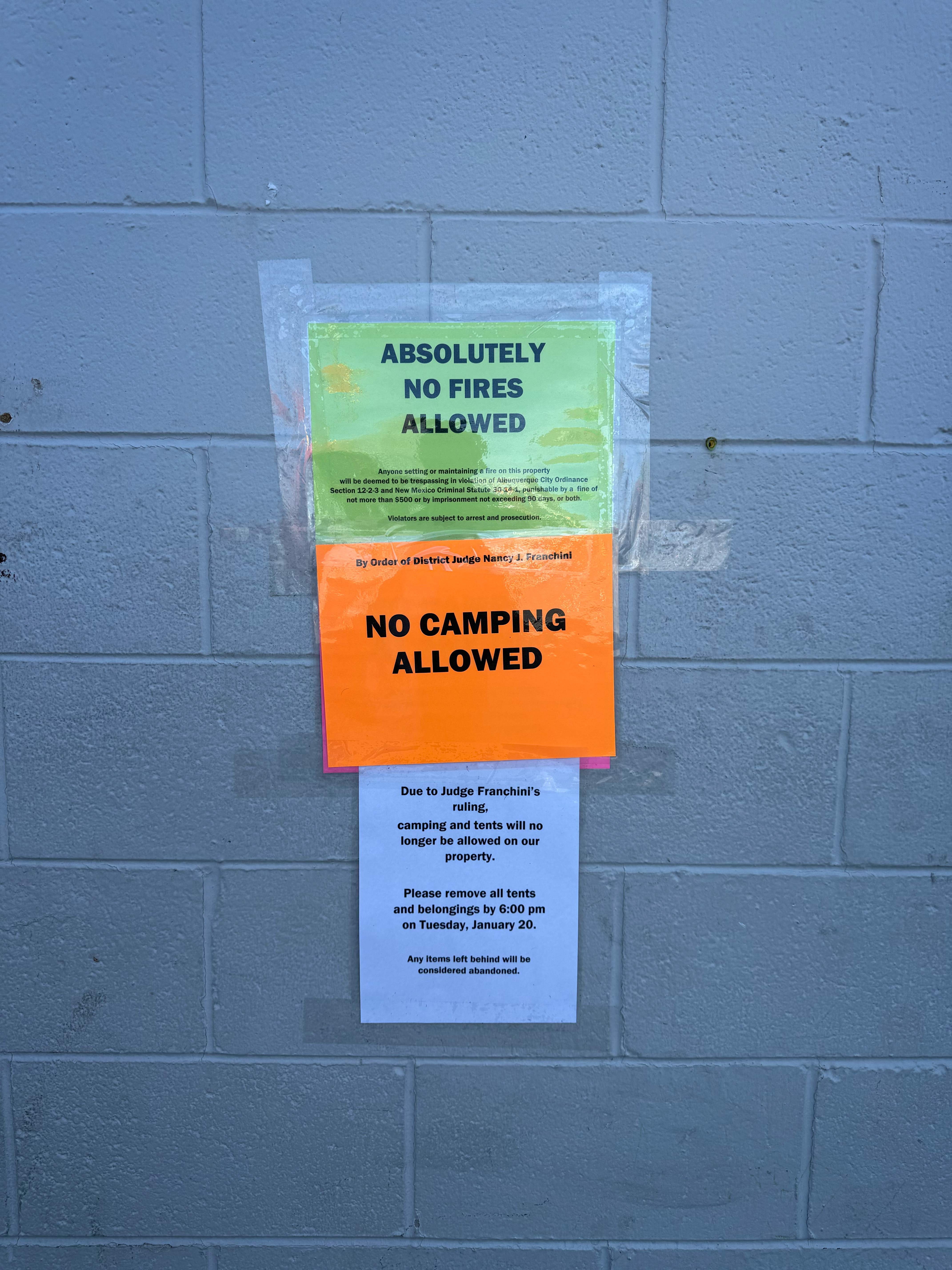
Quirky Books was officially a public nuisance. All the unhoused neighbors would be evicted by Jan. 20. And if Gil didn’t comply, he could be forced to sell the store.
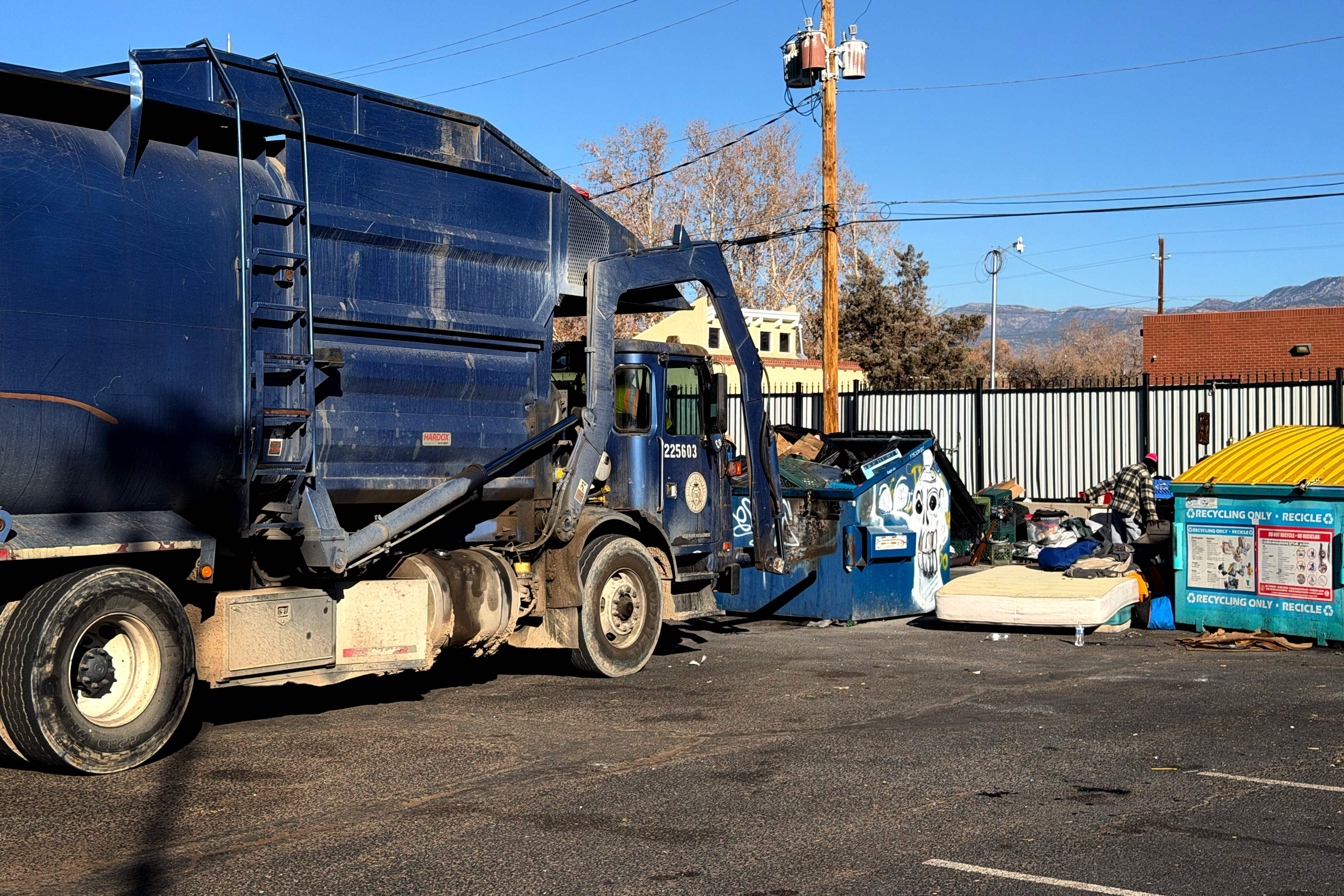
“Moving day” at Quirky Books began the same as every other. Gil, now 65, drove his gray Honda SUV into the store’s parking lot a few minutes after 10:30 a.m. He parked right next to two dumpsters, and the tents—how many? The sanctioned 12, behind the fence, another six, or 10, in the unsanctioned zone. Was it 25 residents? He didn’t linger to count.
He walked around a person sleeping in the entryway. He unlocked the front door. He unlocked the back door. He walked around the store’s premises, picking up trash. In the foyer, beneath the Byzantine-style archway, he swept.
His employee Sawyer had called in sick with food poisoning the night before. “I’ll be here alone all day,” he said.
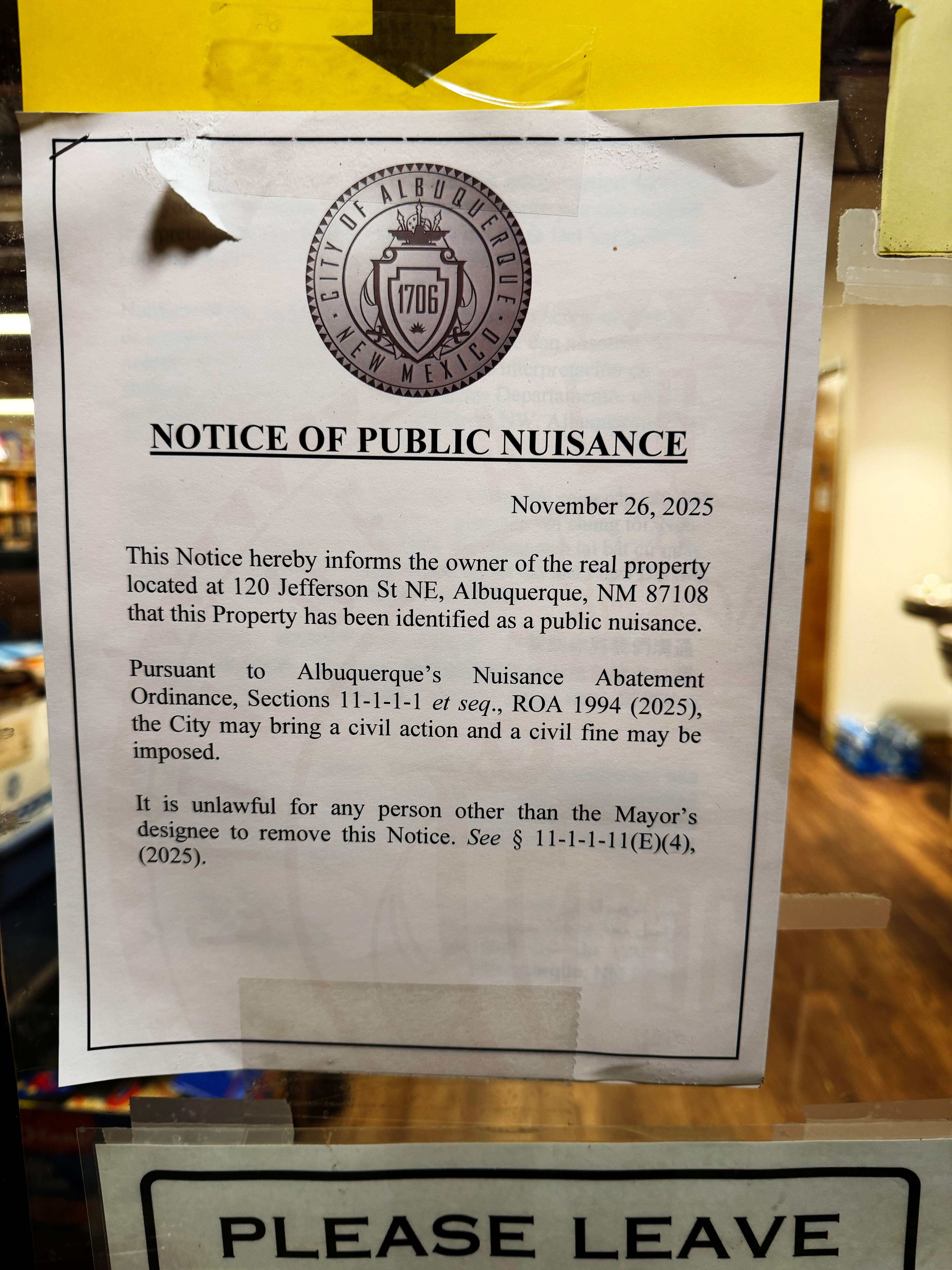
On the door, next to a notice from the city of Albuquerque reading “NOTICE OF PUBLIC NUISANCE,” he flipped the store’s sign to “Open.” He sat down at the counter, and unhoused neighbors came in one after another. “Bathroom?” said one, and Gil gave him a key to the bathroom. “Charge my phone?” asked another, and Gil submitted the device into a tangle of cords growing from a surge protector. “Handwarmers?” “Blankets?” “Are you out of water, Gil?” “Do you have change for $5?” There were requests for hot water for instant noodles and Gil queued up the paper cups and yes, sorry, promised to attend to them in just a moment.
He did not notice that the parking lot of the building next door, home to the Albuquerque School of Healing Arts, was full of Albuquerque city police cars, an armada of black-and-whites.
He sat down at the counter. “We have until midnight,” he told me, but he hoped everyone might be willing to pack it up by 6 p.m.
Then, just before noon, a local TV news reporter came into the store. What did he have to say about the city sweeping his camp in just a few minutes from now, and all the cops that were right outside? the reporter wanted to know.
A few minutes from now? Twelve noon? There must have been a mistake. Gil got out his phone and called his lawyers. “The judge’s ruling, I recall, was just a date,” he said. “I’d been reading it as a midnight deadline. They’re saying it’s a noon deadline.”
It was confusion, or maybe wishful thinking, or was it outright defiance? Gil hustled to the back of the store, opened the back door to the encampment, and called out to the entire population. “We may end up with a police raid in an hour! Please at least get the tents flattened!”
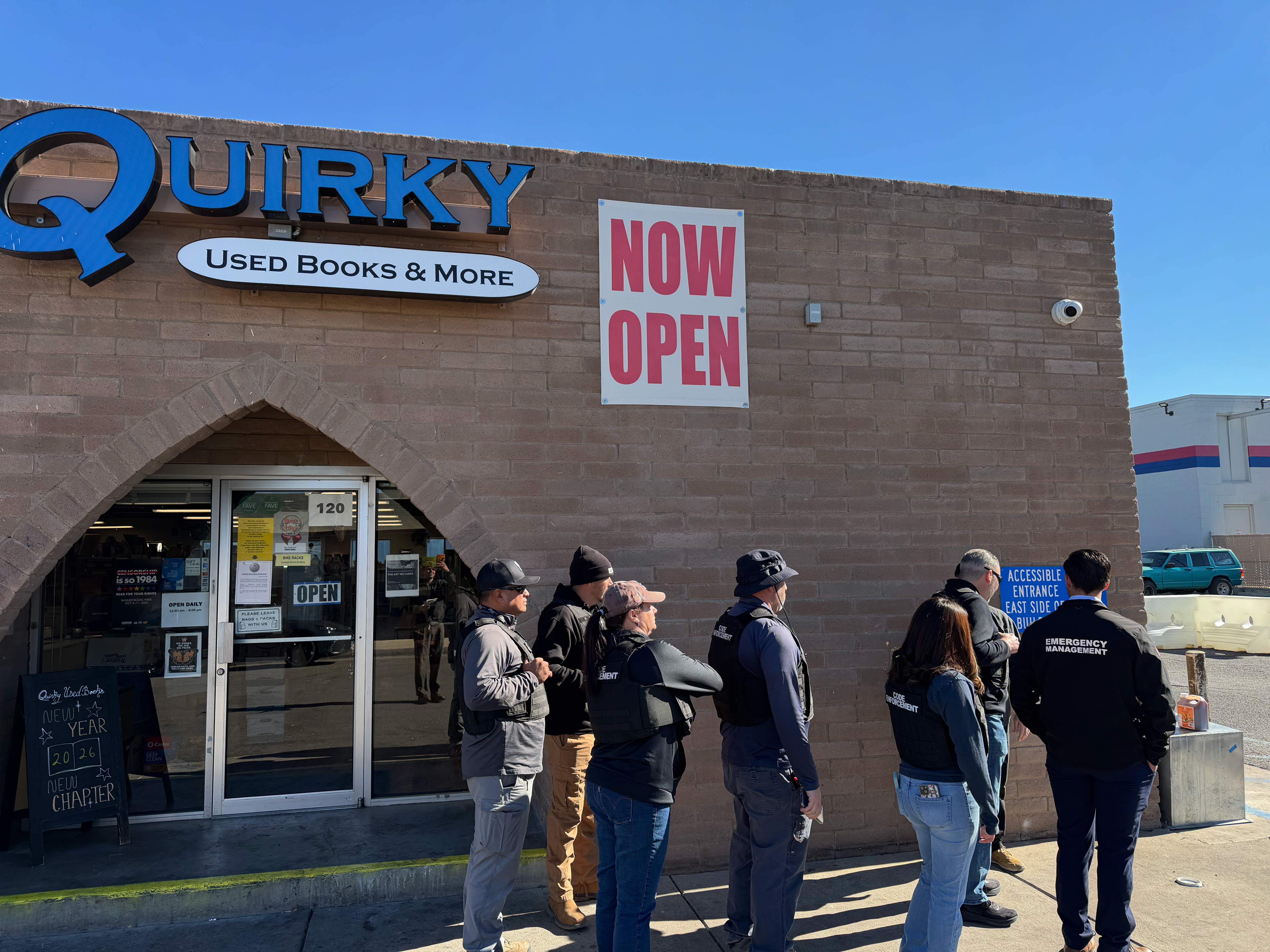
And a few minutes later, at noon on the dot, a column of men and women in flak jackets came marching down the sidewalk of Jefferson Street, double file, straight to the front of the store. There was Code Enforcement, and Emergency Management, representatives from Solid Waste, a group from Albuquerque Community Safety, a liaison from the mayor’s office, and more. All amassed in the street outside Quirky. Green garbage cans were lined up along the entrance to the lot, for people to store their belongings in if they wanted to go into shelters. But they couldn’t stay.
Gil contacted his lawyers to try to buy more time. He paced the aisles. He returned to the back with a verdict: The city agreed to relax the deadline an extra six hours, he declared, though no further than that. “They’re telling me that they’re not forcibly removing people right now,” he told everyone. “If anyone wants to take advantage of any services, or go to a shelter—I know that the shelters are pretty much full,” Gil said.
“We have space,” the city’s representative sharply disagreed.
“Services are voluntary,” Gil said.
And so the tents began to come down, and the suitcases, shopping carts, wagons, bicycles, etc., began to fill up. “By the order of Judge Franchini,” read signs posted around the lot, “NO CAMPING ALLOWED.”
Various members of the Albuquerque Community Safety department crossed onto the property and began asking the residents what they needed. There was bed space, they assured them, there was room at the detox center, there were mental health services and more.
One woman was sneezing repeatedly and couldn’t stop—she was withdrawing from opioids. She decided she wanted to get clean. They helped her to her feet and out of the lot and down the street.
Two women said they would be willing to go to the shelter if there was availability and they could go together, and they could. Another woman said she was ready to go to the shelter once she got her suitcase packed.
“I never thought it would ever come to this,” said Janet, who is in her 60s and had lived there almost three years. “It was a family, a community. This place was a happy little place.”
“Gil did his best to fight for us,” Janet said. “I’ll never forget this part of my life,” she said, and, behind sunglasses, began to sob.
By 2:45, there were only seven tents left. The dumpster was overflowing. A garbage truck came and emptied the contents and drove off. The shadows were stretching out.
“You did a good job,” said one resident, who shook Gil’s hand.
A customer came in and donated some spiral-bound, self-published works. “We appreciate what you’re doing,” he said. “We support.” A customer came in and purchased four books for just less than $30 and said the same.
There were goodbyes, some of them painful. There was anger. “The shit that Gil’s fought for, these knuckleheads took it for granted, they walked all over him,” said Jeremy, who lived there for two years with his dog Sombra, referring to the unsanctioned campers, and maybe some of the sanctioned ones too.
“In Albuquerque, you can get housing in less than six months,” said the former caseworker. “For people to be living in his parking lot for two or three years made no sense.”
Jinx packed up and Evan packed up and Lisa packed up and Dazed packed up. Reyne packed up. People asked each other where they were headed, and the answer was the same. Maybe a friend’s place for a bit, probably back out to the street. They left a lot of stuff behind, piled on the asphalt, promised to come back for it tomorrow, and if they weren’t back by then, I guess just throw it away. And they walked off the lot. The numbers kept dwindling.
And then, at five till 6, there was only one tent left. “We really do need to get the tent down, because it’s getting really close to 6,” pleaded Gil. Inside was Jennifer, and she was sick.
“Dopesick,” clarified Reyne.
But her tent came down, too. It was past 6 then, and a city employee took photos from the street.
And, for the first time in years, the parking lot was empty. It was still full of stranded belongings and furniture and detritus, but there were no neighbors there anymore.
On the sidewalk in front of the store: Well, that was another story. Reyne had sprained his ankle packing, plus his shoe got stolen, he said, so the sidewalk was as far as he had gotten. The two women who wanted to go to the shelter at noon had been shuttled down there, waited for intake, and then, well, something must have happened, because all of a sudden, it was dark, and they were back. Janet had spent so long in the bathroom that ACS eventually left without her.
It was cold—the temperature settled in at 30 degrees—and blue and red light flashed on the wall of Quirky Books from a nearby surveillance tower installed by the police. The group huddled on the sidewalk. An orange car pulled into the parking lot, with a busted taillight, and a few members of the group got up and hobbled over. One by one, they reached through the passenger-side window.
Then the car drove off, and for the rest of the night, no one else came.
“In Gil’s defense, is the city doing enough? No,” said Sarah.
“It’s an environment that was really dark, really dark,” said Ed.
“It was a three-year-long fentanyl party,” said Alfredo.
That night, Gil tidied up around the store, cleaned the bathroom, got ready to close for the day. He stayed later than usual.
“I feel numb,” he said.
“I feel ecstatic. Jesus,” said Alfredo.
The housed neighbors said life on Jefferson Street immediately improved. “Night and day,” said Alfredo. “People are walking their dogs down the street now, it’s pretty nice,” said Sarah. “These homeless people over there,” said Ed, “I think they’re criminals. That sounds a lot more right-wing to me than I would’ve said three years ago, but I think it’s true.”
The unhoused neighbors ended up in other parking lots, other sidewalks, until the cops came. Probably, eventually, some went to jail. Soon, a few were spotted living behind the Salvation Army down the block. The neighbors informed the city. They were monitoring the situation.
I pressed Gil one more time on what possibly could’ve motivated him to do this, to risk his store and his neighbors’ stores too for people he barely knew. “I just believe you have to help people at the bottom,” he said. I believe he believed that.